
Remember that scene in Total Recall where Arnold Schwarzenegger’s character, Douglas Quaid, has to stick a gadget up his nose to remove a tracking bug that’s located in his skull? That’s one of many slightly squeam-inducing references that springs to mind when viewing footage of a new swabbing machine created by scientists at the South Korean Institute of Machinery and Materials.
Designed to help test patients for coronavirus without medical professionals having to get too close, the new invention consists of a head stabilizer support along with an absorbent probe that’s remote-controlled by the doctor or nurse carrying out the test. It also boasts a voice and video comms link between the patient and the people operating the machine, as well as force feedback so that the person carrying out the procedure can “feel” what they are doing.
The reason for the invasiveness of the probe is because the deeper into the nasopharynx the swab goes, the greater the chances that it can pick up the presence of coronavirus in patients. This airway cavity, which is made up of muscle and connective tissue, is far back in the nostril, approximately the depth of an index finger. Needless to say, receiving the swab is not the world’s most pleasant experience, but it’s also one of the best ways we have of testing for COVID-19.
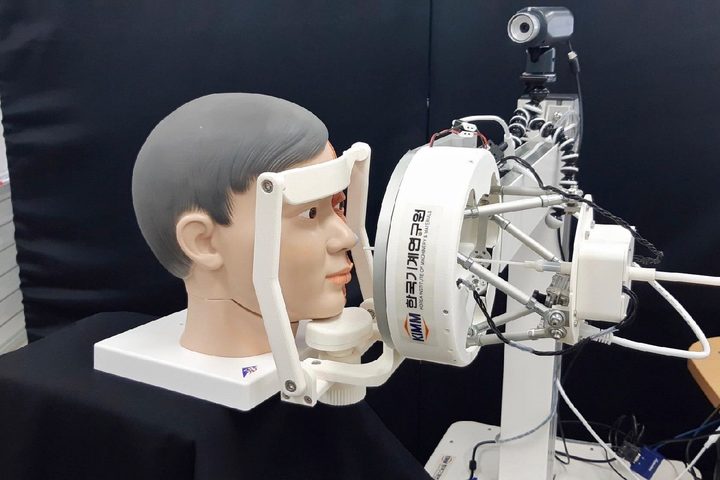
The Korean robot probe machine is just the latest example of telemedicine, in which healthcare workers can carry out procedures from a distance using robots. Last year, a robot was used to help carry out the world’s first long-distance heart operation. Like this latest coronavirus swabbing bot, that robot was controlled using a workstation with multiple joysticks, which allowed the surgeon to control the robot in real time while getting visual feedback about what they were doing.
This distance technology could prove revolutionary for medicine for all sorts of reasons. It might be that the expert needed for a procedure is not in the same physical geographic location as the patient, but their expertise is required urgently. Similarly, it may simply be that the patient may be highly contagious, and this means that the healthcare worker does not physically have to come into contact with them.
Either way, we’re glad this technology exists. Even if we wouldn’t necessarily undergo it for fun.


