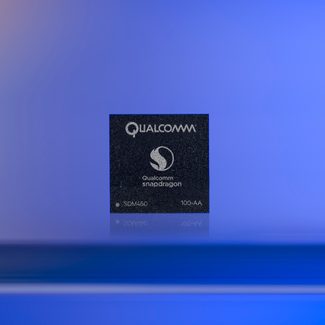
Qualcomm’s Snapdragon processors — the chips that power millions of smartphones, tablets, and PCs — run the gamut from the uber-powerful (the 800 and 600 series) to the affordable (the 200 series), but somewhere in the middle sits the Snapdragon 400 series. It doesn’t pack all the bells and whistles of the high-end chips, but it’s nevertheless uncompromising on battery life, performance, and features. And on Tuesday, Qualcomm made it better with the launch of the Snapdragon 450, the newest flagship in the Californian chip maker’s 400 series.
The Snapdragon 450’s biggest breakthroughs have have to do with raw processing power and battery life. Compared to the Snapdragon 435, its predecessor, the Snapdragon 450 boasts 25 percent faster compute performance and a 25 percent increase in graphics performance. That’s thanks to architectural improvements like a 14nm FinFET design, a first for Qualcomm’s 400 series, and eight 64-bit processing cores clocked at 1.8 GHz (up from 1.2 GHz and 1.4 GHz on the Snapdragon 435).
“When you’re opening up your email client or a social media application […] you’ll see launch times improved,” said Kedar Kondap, Vice President of Product Management with the company. “It’s a very visible user experience enhancement.”
Despite the enhanced compute performance, the Snapdragon 450 sips much less power than the outgoing Snapdragon 435. It consumes 30 percent less on average, which translates to about four more hours of battery life.
“We wanted to enhance the offering, but at the same time provide very good battery life,” Kondap told Digital Trends during a phone briefing.
The Snapdragon 450’s beefed-up power management dovetails with its improved rapid charging. The chip’s Qualcomm Quick Charge 3.0, which supports USB Type-C, juices devices to 85 percent in 35 minutes, or a “full day” in 30 minutes.
Performance and power consumption aren’t the Snapdragon 450’s areas of improvement. Qualcomm’s built-in Hexagon DSP enables camera capabilities like real-time bokeh, which applies a blur effect to the background of images, and Clear Sight, which uses a combination of RGB lenses and black and white sensors to capture greater contrast, more light, and less noise. Those benefits extend to video recording — Snapdragon 450-equipped devices take footage in 1080p at 60 frames per second and automatically suppress background noise.
That’s just the tip of the iceberg.
The Snapdragon 450 sports USB 3.0, which can transfer files at speeds of up to 5 Gpbs compared to the Snapdragon 435’s 0.5 Gbps — fast enough to copy a two-hour movie in three minutes. Its X9 LTE modem can achieve a 300Mbps downlink, thanks to features like 2×20 carrier aggregation, 64 QAM, and 802.11ac with MU-MIMO, and Cat. 6 LTE. There’s precision-enhanced navigation and location tracking onboard, plus eye-based authentication and liveness detection. And the Snapdragon 450 is the first in the series to support iris scanners.
Better yet? It won’t be long before it launches. Qualcomm expects the Snapdragon 450 to become commercially available in the third quarter of this year, and launch in devices during Q4.
“We’ve made many recent changes to the [platform] as part of our vision to deliver the most advanced mobile functionality at the best possible value,” Kondap said. “With the Snapdragon 450, users are going to see a dramatically improved level of performance, connectivity, battery life, and imaging performance.”