1. Home
  2. Space
  3. News

Crew-7 astronauts launch on mission to the International Space Station

Add as a preferred source on Google

The International Space Station (ISS) will soon be getting some new visitors, as four astronauts of the SpaceX Crew-7 mission began their journey to the station at 3:27 a.m. today, Saturday, August 26. Launched using a Falcon 9 rocket from the Kennedy Space Center, the crew will travel in their Crew Dragon spacecraft throughout the day before arriving at the ISS tomorrow.
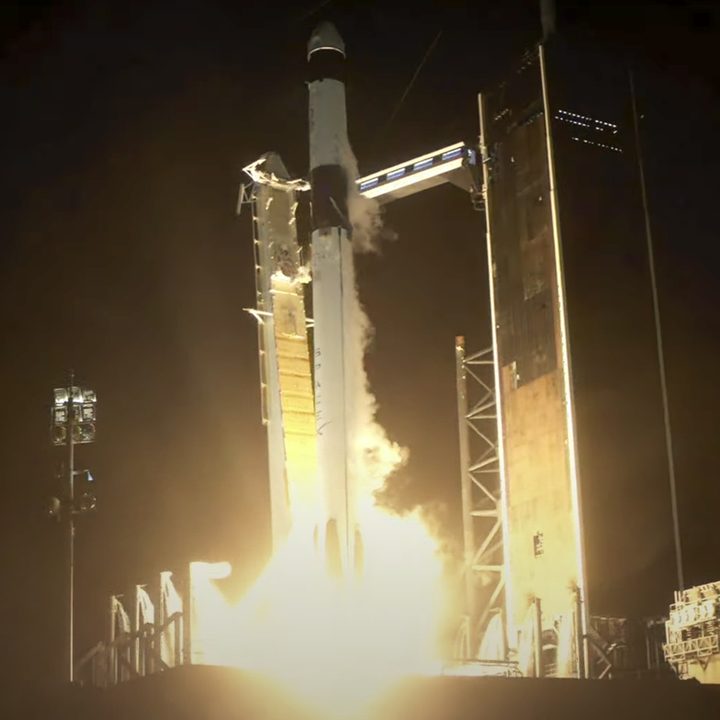
A rocket is launched to the International Space Station at 3:27 a.m. EDT Saturday, Aug. 26, from Launch Complex 39A at NASA’s Kennedy Space Center in Florida.
An international crew of four representing four countries is in orbit following a successful launch to the International Space Station at 3:27 a.m. EDT Saturday, Aug. 26, from Launch Complex 39A at NASA’s Kennedy Space Center in Florida. The agency’s SpaceX Crew-7 mission is the seventh commercial crew rotation mission for NASA. NASA

“Crew-7 is a shining example of the power of both American ingenuity and what we can accomplish when we work together,” said NASA Administrator Bill Nelson in a statement. “Aboard station, the crew will conduct more than 200 science experiments and technology demonstrations to prepare for missions to the Moon, Mars, and beyond, all while benefiting humanity on Earth. By partnering with countries around the world, NASA is engaging the best scientific minds to enable our bold missions, and it’s clear that we can do more – and we can learn more – when we work together.”

Recommended Videos

The launch was delayed for further analysis of the Crew Dragon spacecraft, but it was able to go ahead on Saturday after a delay of around one day. The mission is now scheduled to arrive at the ISS and dock with the station’s Harmony module at 8:39 a.m. ET (5:39 a.m. PT) on Sunday, August 27. The Crew-7 astronauts will open the hatch between their Crew Dragon and the ISS and meet up with current crew members including NASA astronauts Stephen Bowen, Woody Hoburg, and Frank Rubio, plus UAE astronaut Sultan Alneyadi and Roscosmos cosmonauts Sergey Prokopyev, Dmitri Petelin, and Andrey Fedyaev.

The Crew-7 astronauts will stay on the ISS for approximately six months, during which time they will take on duties like overseeing incoming cargo missions and being present when the private Axiom-3 mission arrives. But some of their primary work will be in scientific research, including conducting experiments into sleep in space, taking microbial samples from the outside of the space station, and investigating human health in space.

“The International Space Station is an incredible science and technology platform that requires people from all around the world to maintain and maximize its benefits to people on Earth,” said Ken Bowersox, associate administrator of NASA’s Space Operations Mission Directorate. “It’s great seeing Crew-7 launch with four crew members representing four countries who will live and work on humanity’s home in space as we continue the nearly 23 years of a continuous human presence aboard the microgravity laboratory.”

Georgina Torbet
Georgina has been the space writer at Digital Trends space writer for six years, covering human space exploration, planetary…
China’s answer to SpaceX’s reusable rockets literally catches boosters in a net
SpaceX catches boosters on legs. China just used a net.
Ammunition, Missile, Weapon

SpaceX's playbook for recovering a rocket booster generally involves legs, a precisely controlled vertical landing, and either a concrete pad or a drone ship. 

China just managed to pull off something similar, but in a slightly different way, and on July 10, it tested the method as well.

Read more
Dimming the sun sounds unhinged, but this new study on El Niño makes a surprisingly good case for it
A natural test case, Australia's worst-ever wildfire season, suggests the idea deserves serious consideration.
Nature, Outdoors, Sky

When I first saw "scientists propose dimming the sun," I rolled my eyes. It sounds like a science fiction movie cooked up after watching many climate documentaries. But a new study, published on July 8, 2026, in the journal Science Advances, seems to have a genuinely compelling argument.

A Super El Niño is currently forming in the Pacific, feared to be the most intense in decades. It could escalate floods, wildfires, and extreme heat events worldwide. However, Researchers at UC San Diego's Scripps Institution of Oceanography, led by climate scientists Kate Ricke and Jessica Wan, are now proposing one of the most interesting solutions I’ve come across.

Read more
You can now walk through space and gaze into a black hole at this VR exhibit
Smithsonian Starstruck lets you drift past dying stars and see the origin point of the universe for as little as $18 a person.
Smithsonian Starstruck featured

Most planetarium shows ask you to sit still and look up. The Smithsonian's new VR exhibit takes a different approach, letting visitors walk through the vast expanse of the universe, drifting past stars, planets, and a black hole to get a physical sense of its true scale.

A $29 ticket to the edge of the galaxy

Read more