  1. Home
  2. Space
  3. News

Virgin Galactic reveals the winner of free trip to space

Add as a preferred source on Google

Virgin Galactic has just announced the winner of a free suborbital space ride on a rocket-powered plane.

The lucky winner is Keisha S., a health and life coach and former flight attendant from Antigua in the Caribbean. The prize includes two seats — worth $450,000 each — so Keisha will take along her daughter, a student studying astrophysics.

Recommended Videos

Aiming to squeeze as much publicity out of the sweepstakes as possible, Virgin Galactic founder Richard Branson, who himself took a test flight aboard the company’s VSS Unity rocket plane in July, turned up in person to present Keisha with news of the prize.

Richard Branson Surprises Fan With Virgin Galactic Space Flight // Omaze

A delighted Keisha said: “I’ve always had a lifelong love of flying and a fascination with space, and this is truly a dream come true for me.”

She added: “I hope to share this experience with my daughter so together we can inspire the next generation to follow their dreams.”
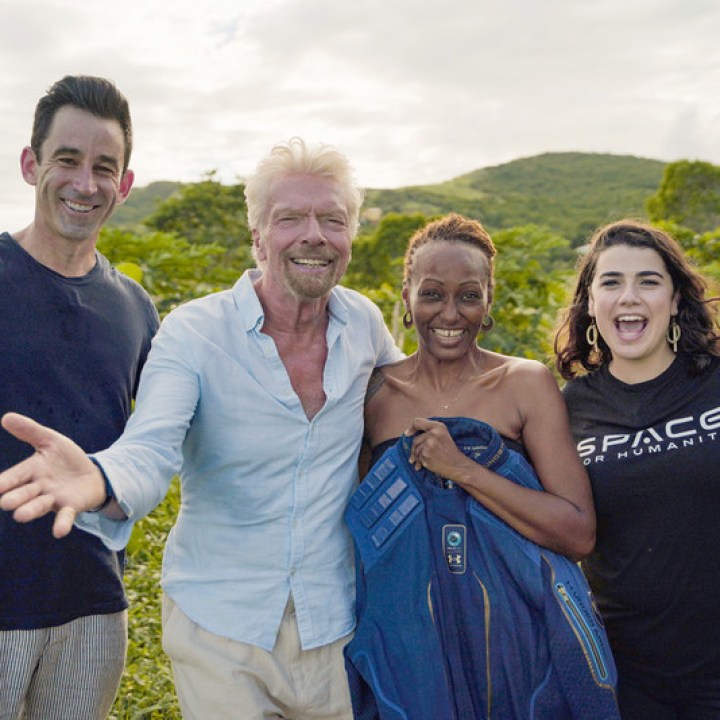
Virgin Galactic sweepstake winner Keisha, second from right, with Richard Branson.
From left: Omaze CEO and co-founder Matt Pohlson, Sir Richard Branson, Omaze winner Keisha, and Space For Humanity Executive Director Rachel Lyons. Virgin Galactic

So what kind of experience awaits Keisha and her daughter? Well, the trip will begin with Unity attached to the VMS Eve carrier plane. Eve will fly to an altitude of around 50,000 feet (about 15,000 meters) before releasing Unity, which will then fire up its rocket to blast the plane and passengers to an altitude of around 283,000 feet (about 86,000 meters). They’ll then experience a short period of weightlessness where they can float around the cabin and enjoy incredible views of Earth. A gentle descent will end with a runway landing.

No date has been set for the flight, though it’s unlikely to happen until the end of 2022 at the earliest as Virgin Galactic is carrying out further testing on Eve and Unity.

The sweepstakes was organized by fundraising platform Omaze and ran from July to September. Entrants were asked to make a donation to the nonprofit Space for Humanity charity.

More than 164,000 people from around the world entered the contest, with donations totaling around $1.7 million.

The proceeds will benefit Space for Humanity’s Citizen Astronaut Program, which is designed to provide a path for more people to experience space travel.

But what exactly constitutes space travel is the subject of ongoing debate, with Virgin Galactic and rival space tourism provider Blue Origin in disagreement about where Earth’s atmosphere ends and space starts.

Either way, the experience offered by both companies is one passengers are likely relish for many years after arriving back on terra firma.

Trevor Mogg
Contributing Editor
Not so many moons ago, Trevor moved from one tea-loving island nation that drives on the left (Britain) to another (Japan)…
SpaceX Starship reaches orbit for the first time but its historic flight ends early
Starship reaches orbit for the first time and deploys 26 Starlink satellites before an early splashdown.
spacex-starship

After 13 suborbital test flights and more than $15 billion in development costs, SpaceX's Starship has finally reached orbit. The 407-foot megarocket, the most powerful ever built, lifted off from Starbase, Texas, on Monday and delivered its first real payload on it's 14th attempt. The celebration came with an asterisk, though, since SpaceX had to cut the planned 10-hour mission to roughly three hours.

https://twitter.com/SpaceX/status/2104601695711904180

Read more
Starship is finally going orbital, and SpaceX has picked September 22
Flight 14 is aiming for orbit, Starlink V3 deployment and a very long day in space.
Starship rocket.

SpaceX is finally ready to give Starship its biggest test yet. The company says the massive rocket's 14th test flight is scheduled for September 22, when it will attempt to put the upper stage into Earth orbit for the first time. The launch is currently pending regulatory approval, with a 75-minute window opening at 7:15 a.m. CT.

Starship has 26 Starlink satellites to deliver

Read more
Want a city on the Moon? Scientists say there’s not enough water
A billion tons still comes up short
Artist impression of activities in a Moon Base.

For decades, humanity has looked up at the Moon and wondered what it would be like to live on it. Think sprawling cities, factories, research centers, and permanent human settlements. Unfortunately, there is one fairly fundamental problem with that vision.

A new study published in Frontiers in Space Technologies argues that even the Moon's potentially enormous reserves of frozen water may be nowhere near enough to support city-sized populations sustainably. Researchers Martin Elvis and Jonathan McDowell estimate that the permanently shadowed regions near the lunar poles could contain roughly one billion tons of water. It sounds like an extraordinary amount until you put a million thirsty humans next to it.

Read more
