Thursday is the 40th anniversary of Skylab falling back to Earth. While most people know it as America’s first manned space station, its influence extends much further.
Skylab launched May 14, 1973 and orbited the Earth 2,249 times before it fell to the Earth’s surface, landing in a remote part of Australia on July 11, 1979.
“Skylab’s biggest legacy was that it was a teaching tool,” author and filmmaker Dwight Steven-Boniecki, who directed the documentary Searching for Skylab, told Digital Trends. “It completely rewrote the book on solar physics.”
Boniecki said he directed the film “to bring light to the lesser known achievements of the space station and its lasting legacy for space exploration.
Bonjecki said that the scope of work and research conducted on Skylab shaped space research forever.
The NASA astronauts who occupied Skylab looked at solar flares for the first time, observed a comet that was the very first time a celestial object had been seen from outer space, observed cyclones and hurricanes to get a better understanding of how to predict them, and took more than 170,000 photos of the Sun and 46,000 photos of the Earth.
“[The astronauts] had eagle eyes for these things that we take for granted today,” Bonjecki said.
When you think of Skylab, though, most people think the station physically impacting Earth, and not necessarily its impact on research. Bonjecki said that since it went into space closely after the Apollo 11 moon landing, most people were already “unimpressed” by space exploration.
“Skylab itself didn’t really have a hype. It’s a forgotten era because it falls in the shadow of Apollo 11,” he said. “In the collective consciousness, if you compare it to walking on the moon, it’s like, ‘So what?’”
Bonjecki also attributes people’s lack of interest in Skylab because of the Watergate scandal that occurred around the same time. He said much of the media was devoted to covering that, rather than the space station.
But Bonjecki was always interested in Skylab’s discoveries and histories.
“I was terrified that Skylab was going to hit my house as a young 10-year-old boy living in Australia since we knew that Australia was in the flight path,” he said. “When I woke up the next morning it was all over the news that it had impacted Australia and it had become a media frenzy all over the world.”
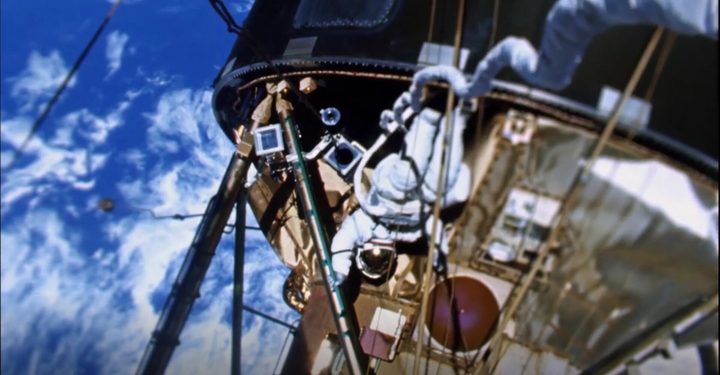
Since then, Bonjecki pored over the research, the photos and the videos that were captured on Skylab, eventually creating his film. He said he reviewed 600 plus hours of footage, including rare footage shot on the space station itself.
Bonjecki said he hopes his film helps people get a better understanding of Skylab how it’s impact science over the past 40 years.
“They left no stone unturned in regards to data they could collect [on Skylab],” he said. “The sheer amount of data that was found is astounding.”