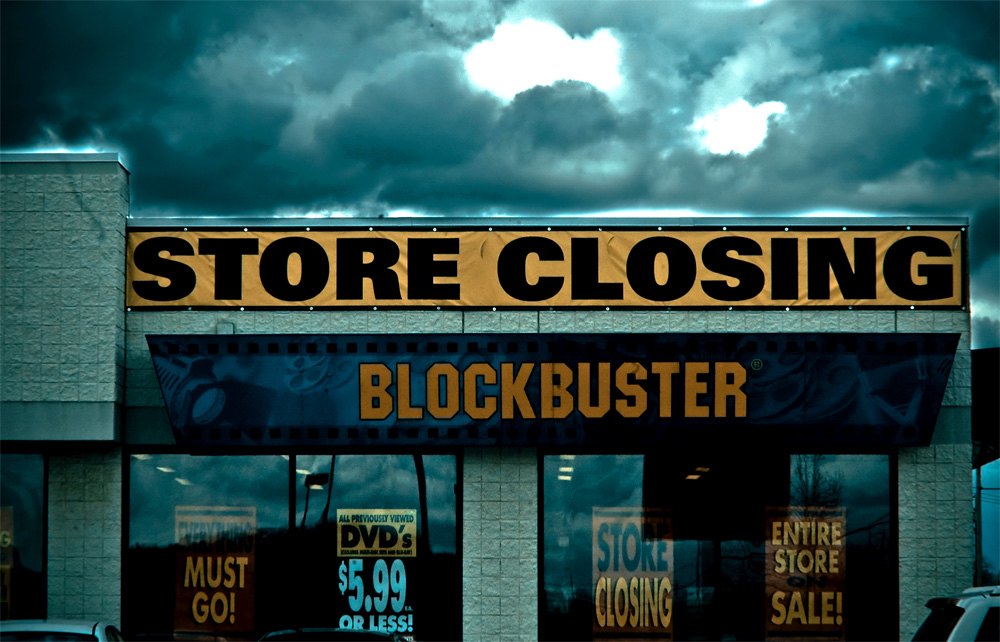
Last weekend, while home visiting family, the holiday spirit moved me to rent Max Payne 3. My younger brother had just moved into his first apartment, and seeing the Xbox 360 plugged in and ready to go without a new(ish) game to go with it just seemed, well, wrong. We had both grown up playing Max Payne on the PC, so the choice was easy. A year ago the rest would have been relatively straight forward: Call around to the local Blockbusters, find one with the game, drive, checkout, come home, play. But a lot has happened in a year, and the last of the brick and mortar Blockbuster’s in our Connecticut suburb of just over 50,000 closed its doors last February. Now it’s a Men’s Warehouse.
The demise of the video-rental store has been imminent since Netflix first began mailing out DVDs by mail over a decade ago. Kiosks like Redbox and streaming services like Hulu drove the final nails in the coffin. But now that video-rental stores are all but gone, I realize something: I miss them. As fine as the high-tech substitutes are, they can’t totally replace everything the old brick-and-mortar store provided.
My quest to find Max Payne 3 without the help of Blockbuster only reinforced this fact. First stop: Redbox. I used the Redbox Mobile iOS app to locate the nearest Max Payne in seconds, sitting at a Redbox in a Walgreens parking lot. My brother and I jumped in the car. When we showed up around 7 p.m. on a Saturday night, a line stretched around the building. It was about 40 degrees, dark, and Walgreens was practically empty. Yet to my bewilderment, this Redbox had a line. So we waited, and cars continued to drive up. We waited, and moms and kids and everyone else took their places in line.
Half the people in line were actually returning games and movies, and it was taking even longer for them than it was for the folks trying to rent. You see, if you’ve never used one of these things before, each disc has its own plastic case, and the Redbox kiosk only has one single slot for all these little cases. So you have to insert each case individually, and each time, go through a process on the built-in touchscreen similar to a CIA entrance exam. Each time. Gone are they days of the drive-up drop-off box. Behold, The Future.
When we finally reached the front of the line, my hypothermic fingers could hardly navigate the clunky touchscreen, and yet — fortune! Max Payne was still in stock, and within moments that forsaken little plastic case popped out and we’re back in the car heading home, game in hand.
Max Payne 3 rules, for those of you who haven’t yet had the pleasure of checking it out. But my woes don’t end there. Max Payne 3 for Xbox 360 is a really long game — long enough that it actually requires two discs. And here we are, my brother and I, playing late into the night, dedicated, when all of a sudden: “Please insert disc 2.”
Now, I’m admittedly not much of a gamer; I’ve got a Wii, and mostly it just comes out for parties. But when I’ve invested untold hours into an interactive fictional narrative of superior quality, I want to, you know, be able to finish it. Well, it turns out Redbox doesn’t do two-disc rentals, not even if disc two happens to be half the game. Why do they have this asinine policy? Is it ignorance or sadism? And what do they do with all those second discs? Someone, somewhere, has quite a terrifying collection — like the Island of Misfit Toys, but shinier.
Death of the disc
How did we get to this strange state of affairs? A decade of disruption.
Netflix became the juggernaut it is today by starting out physical. You could rent practically any movie or television show in history with a couple of days notice, no late fees, no shipping, done deal. A direct-mail arrangement like that made Blockbuster’s overhead (physical locations require rent, heating, electricity, not to mention the cost of employees) seem absurd. Netflix, and a bevy of imitators in industries that stretched from book publishing to porn, thrived. Blockbuster itself even got in on the mail-order game, but its legacy infrastructure made this a losing battle. Then it tried to mimic Redbox’s success with Blockbuster Express Kiosks. How did that go over? Last February, NCR, the company that supplied and managed Blockbuster’s kiosks, sold itself for $100 million…to Redbox.
Redbox is a subsidiary of the same company that brought us the omnipresent Coinstar. It’s not hard to tell; they are practically the same machines, and they tend to show up in the same locales, like grocery stores and pharmacy parking lots. In 2007, Redbox surpassed Blockbuster in number of US locations, and exceeded 2 billion rentals earlier this year, all in direct defiance of streaming services like Netflix, Hulu, iTunes, and Amazon Prime.
As broadband Internet became faster and more reliable, as DSL moved to high-speed cable and cable moved to fiber optic, streaming services could afford to push out higher quality HD content. As those services matured, major movie studios and networks signed on to multi-year content deals for fear of being shut out of the future of online distribution. For a little while, it seemed like a golden age of media consumption: For a low monthly fee, consumers had access to the new, the old, and the quirky, huge libraries of media streamed directly to computers or tablets or TVs.
Then studios started to push back. When its contract came up for renegotiation last year, Starz dropped off Netflix. Instead of signing on with a streaming partner, HBO decided to go it alone and create its own app, HBO GO. And in just the last few months, rumors have grown louder that many of the major movie studios, led by DreamWorks, will rally around their own forthcoming streaming service, called M-Go.
Halfway there
As I sat with half of Max Payne 3 finished and unable to start the second half, my own state mirrored that of the industry. In our shift from brick-and-mortar to streaming, we seem to have hit the awkward teenage years where one phase is behind us and the next hasn’t quite arrived.
Streaming content is far more convenient than traditional video stores ever were. For the most part, it’s cheaper than its old-school equivalent too, and has bred a whole galaxy of devices without need for massive internal storage or clunky optical drives. Soon, all our media will be served up this way, because if you can transfer something over the Internet in the same amount of time that it takes your device to read its own hard drive, why not?
But we are not there yet. There are still thousands of films, both indies and majors, that are unavailable on any streaming service. Because of the fragmented nature of the streaming industry, there isn’t one player that you can bank on to have it all, and here’s the really scary part: There probably never will be. The Internet has changed the nature of content delivery irrevocably. It’s unlikely that any single entity will ever have the power to lobby the content industry like Blockbuster had, because the ways content can be served up now are manifold — and that’s both good and bad. But it didn’t stop streaming services from decimating the physical rental industry without a cohesive model to replace what we as consumers lost.
The game industry is even worse. Gamefly fills the void that Netflix did years ago, but consoles are still generations behind in their ability to download and stream games wholesale, and forget renting. Redbox has arisen, a not-quite-phoenix from Blockbuster’s smoldering blue ashes, but it’s only a stopgap, and a poor one.
So here we stand at the crossroads of the future and the past, which, it turns out, looks a lot like a line snaking around a closed Walgreens on a cold Connecticut night. We can land a rover on Mars and watch the live stream on YouTube, but we can’t get a two-disc game from a hacked Coinstar machine. I miss Blockbuster.
Image source: Jared Presley
Editors' Recommendations
- Plex is now a social media platform for movie and TV fans
- Bluetooth headphones have been on planes for 10 years, so why do I still need a cable?
- Why you may still be missing ESPN and other Disney-owned channels on YouTube TV
- Roku calls Google an ‘unchecked monopolist’ as ongoing YouTube TV spat rages on
- Why 2021 could be the beginning of the end for cable TV