Crafting a proper bottle of tasty wine consists of equal parts science and quality ingredients, together with a healthy dose of patience. After all, fermentation processes tend to take anywhere from one to three weeks — and that’s before you even start to think about aging the batch.
Well, if you could believe it, a duo of researchers hailing from Iowa State University and the Ecole polytechnique federale de Lausanne (EPFL) in Switzerland have just successfully created a “micro winery” that can continuously produce wine at 1 milliliter per hour, completely bypassing the fermentation process altogether.
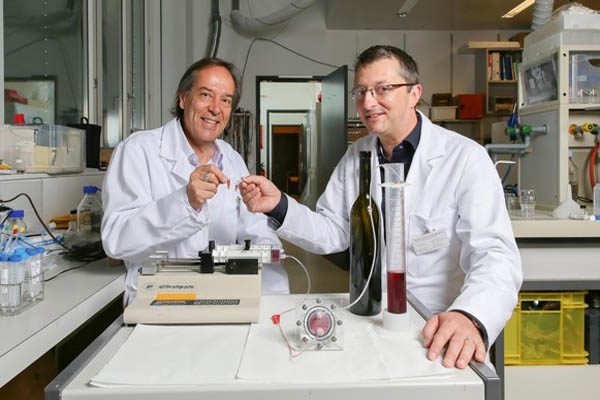
Created by ISU professor Daniel Attinger, the micro winery intends to help winemakers achieve a better understanding of wine’s fermentation processes and allows them to test fermentation methods. Attinger, a former EPFL student himself, developed the schematic to address the rising issue of climate change and its inherent effect on grapes all over the globe. By utilizing his experience in the field of multiphase microfluidics, Attinger decided to create a device which boasted the ability to instantly recognize a fermentation process’ ideal temperatures and yeasts.
“Due to the heat, some crops ripen too quickly, the harvest takes place sooner and the wines end up with a higher alcohol content or a different taste,” Attinger said in a press release published by EPFL. “We need to find ways to analyze and adapt how the wine is made.”
Typically, winemakers spend an overwhelming amount of time simply selecting different types of yeast to put into their batches of wine. After waiting the required one to three weeks for the wine to ferment, these winemakers then have the ability to compare and contrast the different tasting notes and characteristics of the wine.
The thing is, if a batch doesn’t quite hit the mark, the entire process could end up being a complete waste of time. And going back to the drawing board means another one to three weeks of waiting.
“Let’s say a winemaker in the Lavaux region of Switzerland finds that a certain type of yeast or a certain fermentation temperature leads to an overly bitter wine,” Attinger added. “We could quickly test alternatives. At a traditional winery, it takes weeks to separate the yeast from wine, because they’re mixed together. That’s not a problem here.”
Attinger’s micro winery works by featuring a primary channel by which the juice drawn from grapes flows. Yeast is then placed in neighboring compartments which allows it to infiltrate the main channel directly via the miniature pores of a light membrane. As the grape’s juice meets the yeast, it emits alcohol and CO2 to the membrane by absorbing sugar. What’s perhaps most impressive about the device is that this process happens instantaneously.
As expected, Attinger’s contraption has already caught the attention of winemakers and educators all over the world. Viticulture and enology schools have already planned on using the micro winery to characterize various types of yeast and experiment with related concepts.