Fake news has been one of the big topics of conversation over the past few months, with some media outlets even going so far as to pin the election of president-elect Donald Trump on the circulation of misinformation online.
Well, as the late Steve Jobs might have said “there’s an app for that” — or, at least, a web extension.
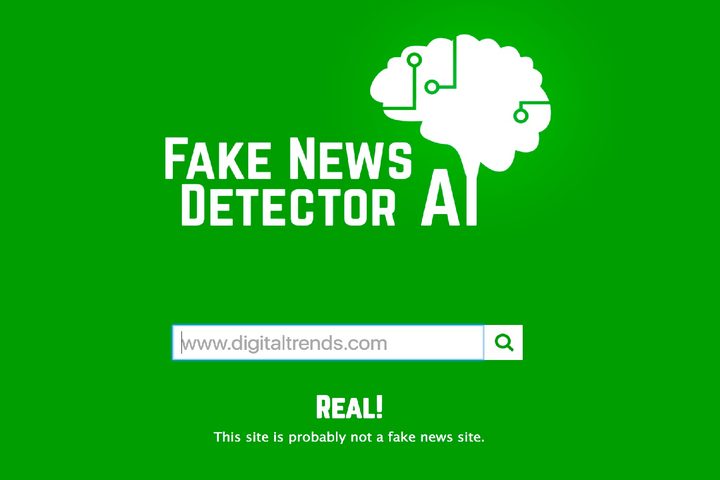
Called the Fake News Detector AI, 19-year-old Stanford University student Karan Singhal has developed a tool he hopes will help already-busy users sort the online wheat from the chaff, courtesy of the latest artificial intelligence tools.
“The project is an AI that aims to detect fake news by analyzing a website’s content, writing style, layout, domain name TLD, use of keywords, popularity, and a bunch of other factors,” Singhal told Digital Trends.
In all, there are 55 different metrics the system bases its decisions on, while under the hood a neural network attempts to make predictions about real or fake news by combining the different factors numerically. If the resulting number is above a certain threshold, it considers the site to most likely be fake news, while other sites are classified as real.
“I came up with this after I encountered fake news sites on my own news feed,” Singhal continued. “I realized these sites are often fairly easy to tell apart from real sites: They often run on WordPress blogs, they are unpopular relative to established news sites, they display unlikely headlines like ‘Liberals’ Heads EXPLODED When They Heard This.’ It wasn’t hard to guess whether most of these sites were fake or not because I was combining a bunch of factors correlated with reliability in my head to produce a guess.”
It’s certainly an intriguing concept and we were happy to see Digital Trends cast firmly in the real news camp. Whether it does its job accurately, however, is another issue. While there is certainly fake news out there on the internet, the thought of letting an algorithm decide on whether a website is worth reading, as opposed to doing your own research, is somewhat problematic.
Nonetheless, if you view this as a fun computer science project as opposed to a 100 percent accurate view of what is and isn’t genuine news, it’s definitely interesting to explore.
You can check out the Fake News Detector AI here, or even consider installing a Chrome extension.