1. Home
  2. Space
  3. News

James Webb telescope captures stunning view of a famous supernova remnant

Add as a preferred source on Google

One of the satellite galaxies of the Milky Way, the Large Magellanic Cloud, is famous as the host of the nearest supernova to Earth in recent history. Supernova SN 1987A occurred when a massive star ran out of fuel and collapsed at the end of its life, setting off an enormous explosion that threw out a shock wave so powerful it reshaped the dust and gas around it for millions of miles in every direction.

That supernova left behind a remnant, a ring-shaped structure created as the shock wave traveled outward over time. This glowing ring has been frequently observed since the supernova was first seen in 1987. Now, the James Webb Space Telescope has provided one of the most detailed views yet of this stunning structure that was created from a destructive explosion.
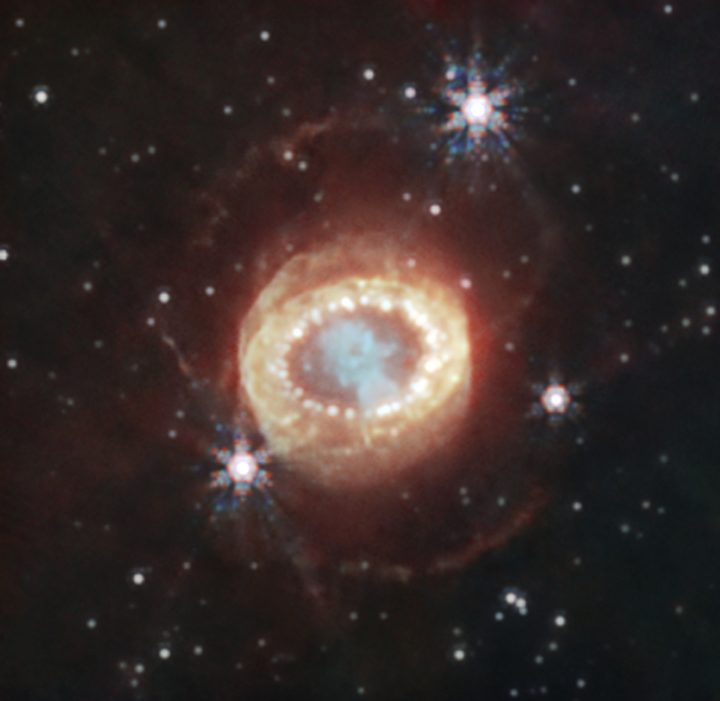
Webb’s NIRCam (Near-Infrared Camera) captured this detailed image of SN 1987A (Supernova 1987A). At the center, material ejected from the supernova forms a keyhole shape. Just to its left and right are faint crescents newly discovered by Webb. Beyond them an equatorial ring, formed from material ejected tens of thousands of years before the supernova explosion, contains bright hot spots. Exterior to that is diffuse emission and two faint outer rings. In this image blue represents light at 1.5 microns (F150W), cyan 1.64 and 2.0 microns (F164N, F200W), yellow 3.23 microns (F323N), orange 4.05 microns (F405N), and red 4.44 microns (F444W).
Webb’s NIRCam (Near-Infrared Camera) captured this detailed image of SN 1987A (Supernova 1987A). At the center, material ejected from the supernova forms a keyhole shape. Just to its left and right are faint crescents newly discovered by Webb. Beyond them an equatorial ring, formed from material ejected tens of thousands of years before the supernova explosion, contains bright hot spots. Science: NASA, ESA, CSA, Mikako Matsuura (Cardiff University), Richard Arendt (NASA-GSFC, UMBC), Claes Fransson (Stockholm University), Josefin Larsson (KTH); Image Processing: Alyssa Pagan (STScI)

This image of SN 1987A was taken using Webb’s NIRCam instrument, and it shows a central keyhole-shaped structure full of dust and gas that was thrown off by the dying star as it came to the end of its life. While Webb’s infrared instruments are useful for looking through dust to reveal structures beneath, in the very center of the remnantm the dust is so dense that even infrared light cannot penetrate it, hence the dark clump in the very center.

Recommended Videos

The rings of material around the center are seen in more detail too, like the bright dots, which are hotspots created by the shock wave from the supernova hitting previously cast-off rings of material.
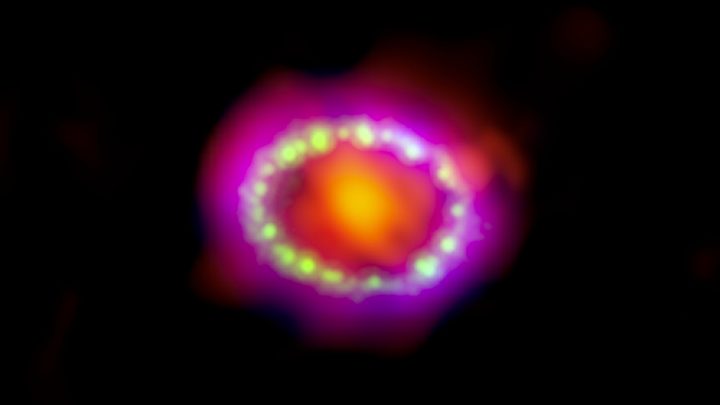
Astronomers combined observations from three different observatories (Atacama Large Millimeter/submillimeter Array, red; Hubble, green; Chandra X-ray Observatory, blue) to produce this colorful, multiwavelength image of the intricate remains of Supernova 1987A.
Astronomers combined observations from three different observatories to produce this colorful, multiwavelength image of the intricate remains of Supernova 1987A. NASA, ESA, A. Angelich (NRAO, AUI, NSF); Hubble image: NASA, ESA, and R. Kirshner (Harvard-Smithsonian Center for Astrophysics and Gordon and Betty Moore Foundation) Chandra image: NASA/CXC/Penn State/K. Frank et al. ALMA image: ALMA (ESO/NAOJ/NRAO) and R. Indebetouw (NRAO/AUI/NSF)

As a famous supernova, SN 1987A has been previously observed many times before, including by space-based tools like the Hubble Space Telescope and the Chandra X-ray Observatory, as well as ground-based tools like the Atacama Large Millimeter/Submillimeter Array.

The image above shows a combination of data from these three observatories, which operate in the optical, X-ray, and radio wavelengths respectively. These observations show the same structures as the Webb image, but in less crisp detail — demonstrating how useful Webb’s instruments are for getting a fresh look at well-known objects.

Georgina Torbet
Georgina has been the space writer at Digital Trends space writer for six years, covering human space exploration, planetary…
Space is becoming Bezos and Musk’s next data center site, and we have every reason to worry
The AI boom is coming for the night sky
How Vast's space station will look in orbit.

AI data centers already consume vast amounts of electricity and water on Earth, so Silicon Valley has begun looking somewhere considerably more spacious... literally.

Elon Musk's SpaceX and Jeff Bezos' Blue Origin, along with several other companies, have proposed enormous constellations of satellites designed to operate as orbital data centers. However, environmental groups and former space officials are now warning that putting them into orbit at the proposed scale could have severe consequences for Earth's atmosphere and the night sky.

Read more
The first possible exomoon is here, and it makes our Moon look hilariously tiny
Scientists may have found the first exomoon, except this one is the size of Jupiter
This artist’s concept depicts a potential volcanic moon between the exoplanet WASP-49 b, left, and its parent star. New evidence indicating that a massive sodium cloud observed near WASP-49 b is produced by neither the planet nor the star has prompted researchers to ask if its origin could be an exomoon.

We have already discovered more than 6,000 planets outside of our immediate neighborhood. Yet, finding a moon orbiting one of those distant worlds has proved considerably harder. Astronomers may finally have something close to the real deal, but this particular object stretches the word “moon” almost beyond recognition.

Using the European Southern Observatory’s Very Large Telescope in Chile, researchers detected strong evidence for a moon-like object in the CD-35 2722 system. Further observations are still necessary to confirm the discovery, but it could become the first confidently detected natural satellite outside our solar system. There is still one tiny complication though. This moon is apparently massive.

Read more
China’s answer to SpaceX’s reusable rockets literally catches boosters in a net
SpaceX catches boosters on legs. China just used a net.
Ammunition, Missile, Weapon

SpaceX's playbook for recovering a rocket booster generally involves legs, a precisely controlled vertical landing, and either a concrete pad or a drone ship. 

China just managed to pull off something similar, but in a slightly different way, and on July 10, it tested the method as well.

Read more