  1. Home
  2. Cars
  3. Emerging Tech
  4. News

The world’s first autonomous buses will debut in Switzerland in spring 2016

Add as a preferred source on Google

As driverless cars continue to undergo testing on the streets, one company is applying the technology to public transportation. Swiss startup BestMile has developed a system to control fleets of autonomous vehicles, which the company compares to the functionality of an airport control tower. The company acquired its first commercial contract by teaming up with PostBus (known as CarPostal to the Swiss French), a major bus operator in Switzerland and France.

BestMile was founded in January 2014 by two graduates from the École Polytechnique Fédérale de Lausanne (EPFL). Since then, the new company and the research university have been working together to develop algorithms for autonomous public transportation. These buses will face traffic, pedestrians, and other obstacles and must deal with them in a safe and efficient manner. The autonomous system must be reliable, flexible, and able to function alongside existing transport systems. BestMile’s software will allow the operators of these vehicles to be able to monitor, control, and optimize their fleet remotely in real time as needed.
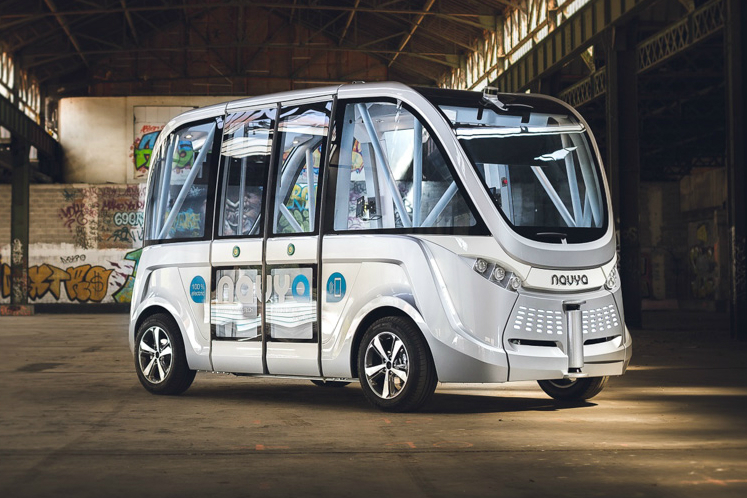
Navya autonomous bus
Image used with permission by copyright holder

BestMile cofounder Anne Koymans cites a leading developer of autonomous vehicles as an influence that led to the company’s first commercial project. “There is a lot of interest for driverless mobility solutions, partly thanks to Google,” Koymans said in an interview with The Local. “Cities are interested but also public transport operators and the interest is increasing.”

Recommended Videos

Koymans points out that while Google aims to put more driverless cars on the road, BestMile is focusing purely on public transportation. There will also be development in what she calls “the last mile,” meaning the leg of a user’s journey between their stop and destination.

BestMile has been seeking funding to improve its developing technology. Previous successful projects include CityMobil2, a pilot platform for automated road transport systems.

French manufacturer Navya is designing and developing the 100% autonomous driverless and electric ARMA buses that will be provided to CarPostal/BestMile. Two existing shuttles have already been sold to CarPostal.

Autonomous buses carrying up to nine passengers will be introduced to the city of Sion, Valais in spring 2016, and will undergo two years of testing.

Albert Khoury
Former Weekend Editor
Al started his career at a downtown Manhattan publisher, and has since worked with digital and print publications. He's…
Xiaomi’s $44,000 SUV that turns into a two-story camper at the press of a button
Chinese EVs just keep getting better and better.
Xiaomi SkyNomad N90 Max Explorer Edition Featured

Xiaomi has officially launched its SkyNomad SUV lineup in China. Xiaomi first revealed the N90 Max’s transforming cabin and rooftop bedroom back in July. The company has now put a price on the dedicated N90 Max Explorer Edition, which costs 299,900 yuan, or approximately $44,100. The regular seven-seat N90 Max starts at 269,900 yuan, around $39,700, making it 30,000 yuan cheaper than its earlier preorder price.

Xiaomi gave the SUV more space

Read more
Audi just built an incredibly efficient EV that squeezes more miles from its battery, but you can’t buy it in the US
Audi's new entry-level EV beats every efficiency number in the brand's history.
Car, Transportation, Vehicle

Audi just built its most efficient electric car ever. However, if you’re in the US, you'll likely only ever see it in photos. 

The company’s pitch is simple and quite intriguing. Its A2 e-tron doesn’t sport the largest battery on an Audi, but focuses on squeezing the most range out of it through smart engineering. 

Read more
China’s latest budget EV costs under $7,000, and it’s basically a four-seat electric go-kart
A $6,540 electric car with a giant rear wing? Yes, I'll take it.
Geely Panda Mini Featured

I have a soft spot for tiny cars, and China has a bunch of them. Geely’s latest Panda Mini takes that form and puts an electric engine into it. The updated Panda Mini Karting Edition launched in China earlier today with a CATL battery, four seats, and a rear wing that makes it look pretty sporty for its size.

Its limited-time subsidized price is 43,900 yuan, or around $6,540, compared with a regular listed price of 49,900 yuan, or approximately $7,435. The promotional offer runs through September 30, with additional purchase incentives subject to eligibility. Budget EVs come in many different shapes, but this one has enough personality to make you look twice.

Read more