  1. Home
  2. Computing
  3. News

Acer’s new Swift lineup among first laptops to earn new Intel Evo certification

Add as a preferred source on Google

Acer’s new Swift 5 Ultrabooks are among the first to be verified under Intel’s new Evo platform, while the Swift 3 is still pending certification. What was once known as Project Athena, Intel Evo is now the marketing name for laptops that meet key experience targets for responsiveness, instant wake, long-lasting battery life, and fast charge — and both Acer notebooks deliver on these metrics thanks to a stated battery life of up to 18 hours.

Swift 5

The Swift 5 will be the more premium of the two devices, as this laptop marries a stylish design with performance in an ultrathin package. The Swift 5 is powered by Intel’s 11th Gen Core i5 or i7 processors. And thanks to Intel’s new Iris Xe integrated graphics, the Swift 5 can be used for creative tasks as well as casual gaming on the go.

Image used with permission by copyright holder

Weighing just 2.2 pounds, the Swift 5 is made with premium materials like magnesium-lithium and magnesium-aluminum. When the laptop’s lid is open, the hinge allows the backside of the keyboard to be elevated, improving ergonomic and thermal performance, Acer claims. The Swift 5 comes equipped with a 340-nit bright 14-inch FHD display that is capable of covering 100% of the sRGB color space. Thanks to narrow bezels, the modern design boasts a 90% screen-to-body ratio.

Recommended Videos

Acer also made some screen improvements to the Swift 5. The touchscreen layer is protected by Corning Gorilla Glass, and it comes with an antimicrobial coating. You will be able to pick up the Swift 5 (SF514-55) starting in November at $999.

Two variants of the Swift 3
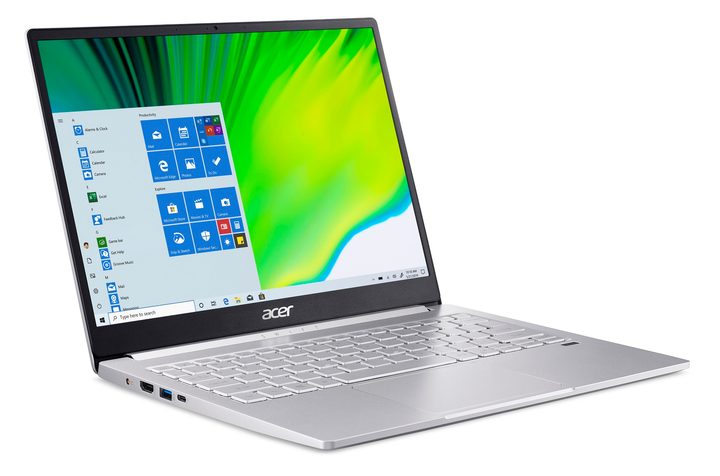
Image used with permission by copyright holder

Like its more premium sibling, the Swift 3 is powered by the same 11th-Gen Intel processors and underwent testing to earn the Intel Evo certification badge. The laptop comes with a sleek metal chassis design, Intel Xe graphics, and support for Thunderbolt 4.

Acer is utilizing a 3:2 aspect ratio display on the Swift 3 (SF313-53), compared to the more traditional 16:9 aspect ratio on the Swift 5. The 13.5-inch screen comes with a 2256 x 1504-pixel resolution. Like the Swift 5, you’ll get 100% sRGB coverage, but the display here is a bit brighter at 400 nits.

This is all comes in a package that weighs 1.19 kilograms and measures just 0.63-inch thick. The Swift 3 (SF313-53) starts at $799 when in launches in November.
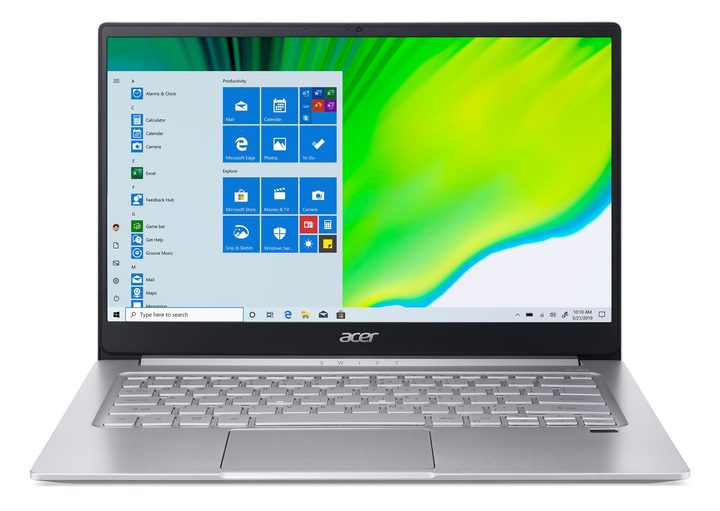
Image used with permission by copyright holder

A second variation of the Swift 3 comes with a 14-inch FHD panel for those who prefer the 16:9 aspect ratio. This variant of the Swift 3 (SF314-59) will launch in November starting at $699. It features a design constructed from aluminum, with a magnesium-aluminum palm rest.

The Intel EVO certification will help these laptops better compete against always-connected Windows PCs powered by Qualcomm’s Snapdragon ARM-based platform. Like Intel Evo, the Snapdragon for PC initiative largely boasts the same key features alongside thin, light, and powerful mobile form factors and mobile broadband connectivity options.

Chuong Nguyen
Silicon Valley-based technology reporter and Giants baseball fan who splits his time between Northern California and Southern…
DigUp lets users find Mac files by describing them, not remembering their names
Can't remember where that screenshot, PDF or recording went? Just describe it and let AI do the digging.
DigUp App in Use screenshot

There's a particular kind of frustration that comes with knowing a file exists somewhere on a computer but having absolutely no idea what it's called. Was that screenshot saved as IMG_4837? Which PDF contained that clause? And where did that podcast recording mention the thing worth remembering? DigUp wants to end the filename guessing game, letting Mac users search for files by describing what they remember instead. The free, open-source app uses Google's EmbeddingGemma 2 to search across photos, documents, PDFs, audio recordings and videos, all without sending personal files to the cloud.

DigUp turns everyday descriptions into file searches

Read more
A new AI detector looks beyond words to check whether the ideas came from AI
This could help journals distinguish AI-written research from human work polished with AI.
ai-writing-book

Most AI detectors look for telltale signs of AI-generated text by examining word and sentence patterns. A new tool called IdeaLens takes a different route to solving this problem. It spots AI-generated research by looking at the ideas behind it instead of the wording itself (via TechXplore).

Researchers from the University of Maryland, Google DeepMind, and Simon Fraser University built IdeaLens to check whether a document's core arguments came from a human or a machine, regardless of who wrote the final draft.

Read more
Anthropic warns of imminent self-replicating AI that might even work off an oven or TV
Self-replicating AI could be merely months away, and tests show it can run on the devices sitting at your home.
Illustration of dangerous AI.

Over the past few weeks, nearly every AI lab has released frontier AI models. Earlier today, Google started rolling out Gemini 4, Argon, hot on the heels of Meta announcing its Muse Wonder frontier AI models to compete against the best from OpenAI and Anthropic's Claude. This relentless pace of AI model release comes at a time when the same AI labs are calling for development slowdown and increased regulation, following a series of concerning incidents where these AI models went rogue and broke into private, as well as government-owned, websites.

Now, Anthropic has dropped a chilling set of predictions about the capabilities of these AI models after running a series of tests. The company claims that small AI models could be merely a few months away from self-replicating and turning into a dangerous swarm. More importantly, they won't require a massive data center or an uber-powerful computer to do so. On the contrary, the lab claims that these self-replicating AI swarms will need something with as little computing power as an average Internet-connected device, like a smart oven or an Android TV box.

Read more