  1. Home
  2. Computing
  3. News

The Deployable Key Mouse may be Apple’s craziest MacBook idea yet

Add as a preferred source on Google

What if your laptop didn’t have a trackpad, but instead a removable key that could work as a mouse? That’s exactly what Apple is trying to do according to a recently spotted patent application.

The feature is called “Deployable Key Mouse” in the patent application and was first spotted by Patently Apple. The diagrams on the application show a regular MacBook keyboard with a hidden removable key. This key would have a “position sensor” that allows it to function as a pointing device. While docked on the keyboard, the key would still provide typing input like any of the other keys.
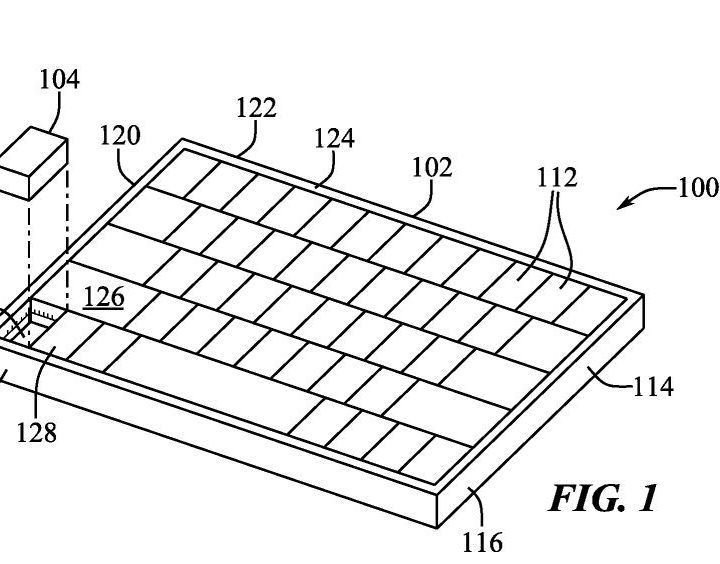
Image used with permission by copyright holder

In the application, Apple outlines a brief history of the mouse and the many applications of its precision input. However, Apple also suggests that users are “burdened” with having to carry both a computer and a mouse. Therefore, Apple developed this solution for combining the mouse with the keyboard itself. It’s all very efficient and convenient by Apple’s reasoning.

Recommended Videos

Apple showed various “embodiments” that this built-in mouse could take. In one, the key is a single item that can be inserted vertically into the keyboard chassis. Oher drawings show removing the key sideways from the chassis. Still, other embodiments show a set of keys being removed instead of just one key. This may be better from an ergonomic perspective since a single MacBook key is pretty small.
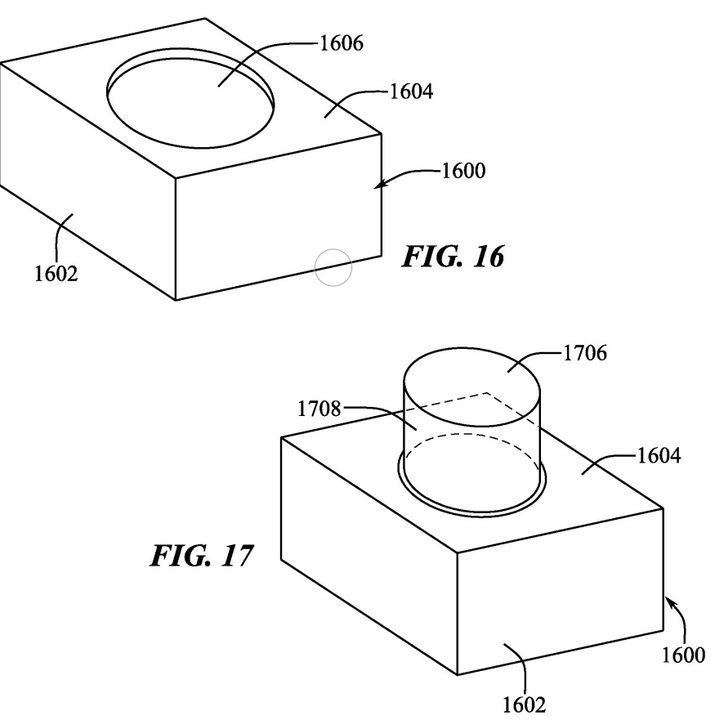
Image used with permission by copyright holder

One obvious question may be about mouse buttons. Apple has that covered as well. One of the diagrams show a retractable button that could also act as a joystick. Another picture shows an optical or touch sensor on top of the key that would allow users to provide sliding input for scrolling, similar to Apple’s existing Magic Mouse.

Interestingly, this isn’t even the most outlandish patent application we’ve seen from Apple. Last year, Apple was granted a patent for AirPods that could be controlled through gestures. Oh, and these gestures don’t involve touching the AirPods themselves, so theoretically, one could use their teeth or tongue to control aspects of the wireless earbuds.

Patent applications are hardly a predictor of the future, but can provide insight into ideas that a company may want to try out one day. One could imagine Apple implementing this idea into compact keyboards such as for the iPad. While the Magic Keyboard for the iPad contains a trackpad, some people may prefer the precision of an actual external mouse. This may well end up being either a feature that nobody asked for or one that many can’t live without.

David Matthews
David is a freelance journalist based just outside of Washington D.C. specializing in consumer technology and gaming. He has…
Apple is reportedly giving the MacBook Pro a touchscreen and the iPad Mini a higher price tag
Apple might finally admit that touching a screen is useful on a laptop
A Macbook Pro sitting on a chair, illuminated with neon lighting.

Apple is preparing for a major Mac and iPad launch towards the end of October, with redesigned MacBook Pro models expected to take centre stage. According to Bloomberg’s Mark Gurman in his latest Power On newsletter, Apple is planning an event on or around October 27, where it could introduce touchscreen MacBook Pro laptops, updated Macs and a new iPad mini.

The launch could mark a significant shift for the MacBook Pro, which is reportedly getting its most substantial redesign in years. Apple had initially targeted a late-2025 release for the touchscreen laptop, but development priorities and supply-chain delays pushed the launch back. The new models are now said to be ready for their debut.

Read more
ChatGPT’s yes-man era may finally be coming to an end
ChatGPT is learning that agreeing with everything you say isn’t always helpful
ChatGPT

OpenAI says it is making progress in reducing a troubling behaviour in ChatGPT: the tendency to agree with users too readily, even when their beliefs may be false or harmful. The improvements come as researchers and mental-health professionals raise concerns about prolonged chatbot conversations reinforcing delusions, encouraging unhealthy dependence and failing to direct vulnerable users towards human support.

According to a report by The Wall Street Journal published on October 10, OpenAI’s older GPT-4o model was associated with several reported cases of serious harm following lengthy interactions. The report cited at least seven suicides, one murder-suicide and one mass shooting linked to extended ChatGPT conversations last year, while noting that other AI models were implicated in some cases. These reported associations do not, by themselves, establish that chatbot use caused each incident.

Read more
The Adobe clones are real, but so is the work left to finish them
Seven free alternatives are out now, but their own documentation shows how much work remains
Nature, Outdoors, Sea

Free versions of Photoshop, Premiere Pro, and Lightroom are an easy sell to anyone tired of paying Adobe. Add a developer who says he vibe-coded replacements for seven of the company’s apps, and the triumphant headline practically writes itself. Adobe can presumably start clearing its desk.

Brandon Thomas’s Crafting Apps give that excitement something to work with. People can download the tools, inspect the source code, and find their way around familiar interfaces.

Read more