  1. Home
  2. Gaming
  3. Business
  4. News

‘Pokémon Go’ has eclipsed $200 million in total revenue one month after launching

Add as a preferred source on Google

After more than a month filled with catching dead bodies, falling off cliffs, purge threats, and tracking systems, Pokémon Go has eclipsed the $200 million milestone in global revenue.

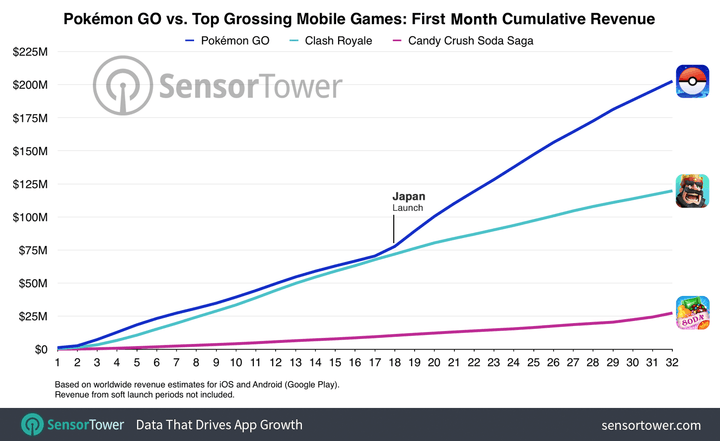
Although setbacks such as bugs, security issues, and other user complaints have risen in the past few weeks, downloads and in-app purchases have done anything but slow down. App analytics platform Sensor Tower released the worldwide revenue data on Friday, citing its latest “Store Intelligence” information. The company also published a chart comparing Pokémon Go’s financial success to that of other previous top earners, including Candy Crush Soda Saga and Clash Royale.
sensortower
Image used with permission by copyright holder

As seen above, Pokémon Go was only slightly outperforming Clash Royale for the first 18 days following its launch, but that was before Niantic Inc. released the app in Japan, Nintendo’s home country, where the biggest Pokéfans likely reside. Revenue exploded from there, spiking from around $75 million to $200 million in just under 14 days.

Recommended Videos

When comparing totals after the first month of launch, Pokémon Go has nearly doubled the success of Clash Royale. The app has also earned almost seven times as much as Candy Crush Soda Saga.

Pokémon Go’s revenue is expected to see more gains in the coming days, as the app just added support in 15 more Asian countries. And that expanded support doesn’t even include South Korea, India, and China, where the app is supposed to go live soon after working through some legal and regulatory concerns involving the game’s reliance on Google Maps.

Sensor Tower also reported on the daily usage number for Pokémon Go, which average approximately 26 minutes per day. With more than 100 million downloads, and the app’s arrival in some of the world’s largest countries looming, expect success to skyrocket once support for more countries is added.

Harrison Kaminsky
Harrison’s obsession in the tech space originated in his father’s electronics store in Denville, New Jersey, where he…
Exclusive: Microsoft explains why RTX Spark’s Prism emulation is about more than higher FPS
Because an erratic 80 FPS will always feel worse than a silky-smooth 60.
ARC Raiders with Anti-Cheat Support running on NVIDIA RTX Spark Laptop

NVIDIA’s RTX Spark may pack a powerful Blackwell GPU, but its ability to run the massive library of existing PC games on Arm depends on a quieter piece of technology: Microsoft’s Prism emulator. Prism allows x64 Windows games and applications to run on RTX Spark’s Arm-based CPU without requiring developers to immediately rewrite them for ARM64.

During an exclusive conversation at NVIDIA’s private IFA 2026 demo, Microsoft’s Peter Dawoud explained that the latest Prism work isn't just about pushing emulated workloads to higher FPS. Microsoft is also focused on performance consistency, particularly in GPU-heavy games where the CPU still has to coordinate frames, physics, and rendering. Because a higher average FPS doesn't always mean a smoother experience, that could prove to be one of Prism’s most important improvements yet.

Read more
I played Star Wars: Galactic Racer at Gamescom, and this is way more chaotic than I expected
Four very different vehicles, dangerous shortcuts and enough mid-race chaos to make even a podracer veteran sweat.
Star Wars Galactic Racer Official Image

The first few minutes with Star Wars: Galactic Racer at Gamescom had me thinking I was playing a very pretty, very modern take on Wipeout. Then the race properly kicked off, and the Burnout DNA came roaring through.

That makes perfect sense, considering Fuse Games was founded by former Criterion developers. But knowing that on paper and actually feeling it while racing are two very different things. This is an arcade racer that really doesn't want you to sit back and admire the scenery. You're boosting, dodging, ramming rivals, dealing with power-ups and trying to pick the right racing line, all while the track throws hazards and shortcuts at you. It's loud, chaotic and, occasionally, wonderfully messy.

Read more
NVIDIA G-SYNC Pulsar is proof that gaming monitors don’t just need more Hz
NVIDIA G-SYNC Pulsar Comparison Image

There is something slightly ridiculous about the gaming-monitor arms race. We now have displays pushing 500Hz, 560Hz, and even 720Hz, with esports gamers understandably chasing every last millisecond. The problem? The faster you go, the more you're often asked to compromise on resolution.

NVIDIA G-SYNC Pulsar takes a very different approach. I got to see it in action at Gamescom, and after watching NVIDIA switch the technology on and off in front of me, I came away thinking that perhaps the industry has been asking the wrong question.

Read more