The recently-launched Solar Orbiter spacecraft has taken the closest-ever images of the sun, showing newly-discovered features called “campfires” which appear to be miniature solar flares.
The European Space Agency (ESA) launched the spacecraft in February this year, with an ambitious mission to capture the first-ever images of the poles of the sun. To achieve this, the craft will use a gravitational assist from Earth and Venus to swing up at an angle from the plane of orbit, which will allow it to pass over the top of the sun for the first time.
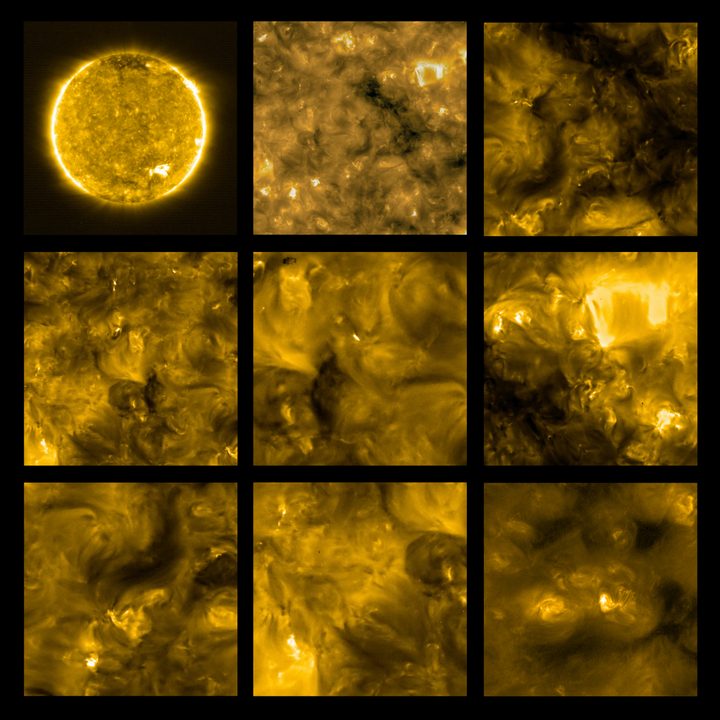
These images represent the closest-ever images of the sun, taken during Solar Orbiter’s first close approach to the sun when the spacecraft came within 77 million kilometers (about 48 million miles) of the star’s surface.
“We’ve never been closer to the sun with a camera,” Daniel Müller, Solar Orbiter Project Scientist at ESA, explained to reporters in a press conference. “And this is just the beginning of the long, epic journey of Solar Orbiter.”
There are other instruments that are closer to the sun that the Solar Orbiter, such as NASA’s Parker Solar Probe, however, this probe does not have a camera facing the sun. Due to the extreme environment that close to the sun, Parker’s camera cannot image the sun directly and instead points away to image solar winds.
The Solar Orbiter, on the other hand, has cameras facing the sun directly, allowing it to capture detailed images of the sun. “When the first images came in, we thought, ‘this is not possible — it can’t be that good,'” said David Berghmans, Principal investigator of one of Solar Orbiter’s instruments, the Extreme Ultraviolet Imager (EUI), the instrument which captured the first images. “It was really much better than what we dared to hope for.”
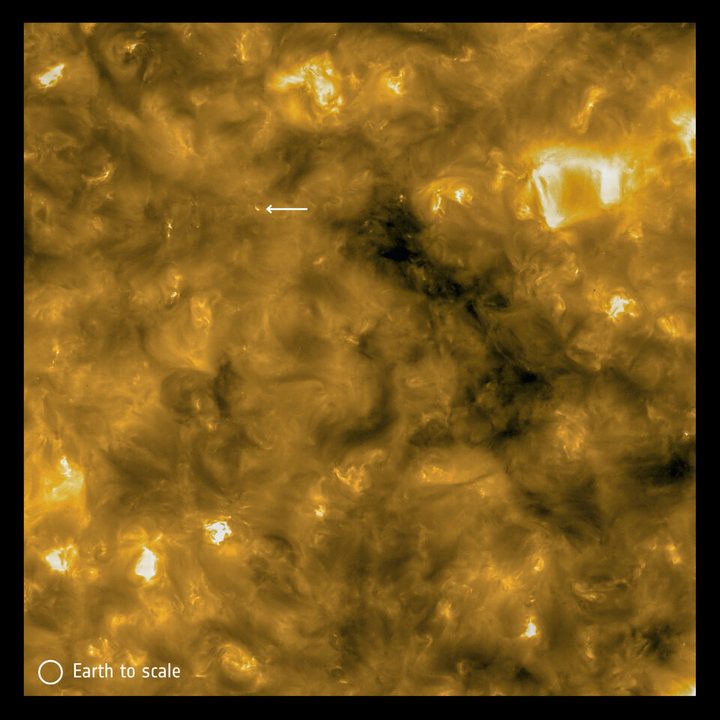
This image shows a part of the sun’s corona, called the “quiet corona,” because scientists had thought this area to have minimal activity. But the high-resolution image shows more activity than was ever expected, with plentiful small-scale features which the scientists have nicknamed “campfires.” The scientists believe these features, which have not been observed before at this small scale, could be caused by changes in the sun’s magnetic fields.
These features could even help to explain one of the biggest mysteries of solar science — why the sun is hotter in the corona than at its surface. Scientists are still puzzled as to why stars would be hotter further out from the center than they are in the middle. These campfires could be a part of a system producing heat which warms the corona. They could be “tiny cousins of the solar flares we already know,” Müller said, producing only relatively small amounts of heat individually but adding up to produce a significant effect due to their number.
The EUI is just one of 10 instruments onboard the Solar Orbiter, including six telescopes for imaging the sun and four in situ instruments that monitor environmental factors like magnetic fields and radio waves. The Orbiter is currently just beginning operations, allowing the scientists to check that everything is working and the spacecraft is in the right orbit, before moving into its full science phase during which all the instruments will be busy collecting data.
These first images are a confirmation both that the spacecraft is working as intended, and of the potential future findings it could enable. “Most importantly, it demonstrates that we are going to be able to accomplish our objectives of Solar Orbiter. We are very excited that everything is working,” said Holly R. Gilbert, Solar Orbiter Project Scientist at NASA. “And it also confirms the importance of looking at different physical scales. We’ve already made some discoveries just from the first light images, so just imagine what we’re going to find when we get closer to the sun.”