  1. Home
  2. Space
  3. News

Mars helicopter Ingenuity gearing up for 7th flight tomorrow

Add as a preferred source on Google

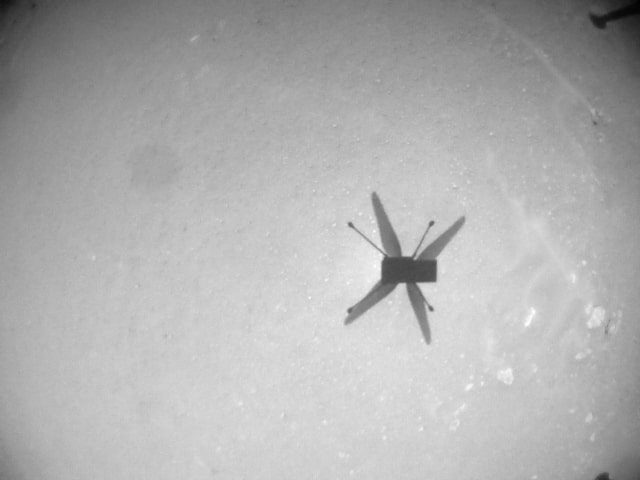
NASA’s Ingenuity Mars Helicopter acquired this image on May 22, 2021 using its black and white navigation camera. This camera is mounted in the helicopter’s fuselage and pointed directly downward to track the ground during flight.
NASA’s Ingenuity Mars Helicopter acquired this image on May 22, 2021, using its black and white navigation camera. This camera is mounted in the helicopter’s fuselage and pointed directly downward to track the ground during flight. NASA/JPL-Caltech

NASA is aiming for tomorrow, Sunday, June 6, for the Mars helicopter Ingenuity to take its seventh flight. The tiny helicopter has succeeded in demonstrating that it is possible to fly an aircraft on another planet, and has been performing a series of increasingly complex flights to test its capabilities. Now, it will be moving to a new location which will act as its latest base of operations.

Recommended Videos

Ingenuity’s last flight, which took place several weeks ago on May 22, was a troubled one. The helicopter took off and began to move as expected, but around a minute into the flight, a number of anomalies occurred. The helicopter changed its speed, tilted back and forward, and showed spikes in its power consumption. Fortunately, it was still able to land safely and did not suffer any damage. In a report on the incident, NASA said that there was a glitch in the helicopter’s motion system which keeps it stable in the air by using its cameras to image the ground below. One single camera frame had been lost, and that had caused subsequent frames to have the wrong timestamp which led to the issues.

NASA’s Jet Propulsion Laboratory, which runs the Ingenuity helicopter, did not say whether the underlying issue had been fixed yet. Presumably, the team is confident that the helicopter can fly safely on its next flight.

The seventh flight will see the helicopter relocate to a new home base — the second time it has moved bases since it began its operations on Mars. NASA writes, “The flight profile will send Ingenuity to a location about 350 feet (106 meters) south of its current location, where it will touch down at its new base of operations. This will mark the second time the helicopter will land at an airfield that it did not survey from the air during a previous flight. Instead, the Ingenuity team is relying on imagery collected by the HiRISE camera aboard NASA’s Mars Reconnaissance Orbiter that suggests this new base of operations is relatively flat and has few surface obstructions.”

Georgina Torbet
Georgina has been the space writer at Digital Trends space writer for six years, covering human space exploration, planetary…
SpaceX Starship reaches orbit for the first time but its historic flight ends early
Starship reaches orbit for the first time and deploys 26 Starlink satellites before an early splashdown.
spacex-starship

After 13 suborbital test flights and more than $15 billion in development costs, SpaceX's Starship has finally reached orbit. The 407-foot megarocket, the most powerful ever built, lifted off from Starbase, Texas, on Monday and delivered its first real payload on it's 14th attempt. The celebration came with an asterisk, though, since SpaceX had to cut the planned 10-hour mission to roughly three hours.

https://twitter.com/SpaceX/status/2104601695711904180

Read more
Starship is finally going orbital, and SpaceX has picked September 22
Flight 14 is aiming for orbit, Starlink V3 deployment and a very long day in space.
Starship rocket.

SpaceX is finally ready to give Starship its biggest test yet. The company says the massive rocket's 14th test flight is scheduled for September 22, when it will attempt to put the upper stage into Earth orbit for the first time. The launch is currently pending regulatory approval, with a 75-minute window opening at 7:15 a.m. CT.

Starship has 26 Starlink satellites to deliver

Read more
Want a city on the Moon? Scientists say there’s not enough water
A billion tons still comes up short
Artist impression of activities in a Moon Base.

For decades, humanity has looked up at the Moon and wondered what it would be like to live on it. Think sprawling cities, factories, research centers, and permanent human settlements. Unfortunately, there is one fairly fundamental problem with that vision.

A new study published in Frontiers in Space Technologies argues that even the Moon's potentially enormous reserves of frozen water may be nowhere near enough to support city-sized populations sustainably. Researchers Martin Elvis and Jonathan McDowell estimate that the permanently shadowed regions near the lunar poles could contain roughly one billion tons of water. It sounds like an extraordinary amount until you put a million thirsty humans next to it.

Read more
