  1. Home
  2. Space
  3. Emerging Tech
  4. News

Who will be the first private passenger to the moon? SpaceX will tell us today

Add as a preferred source on Google
SpaceX

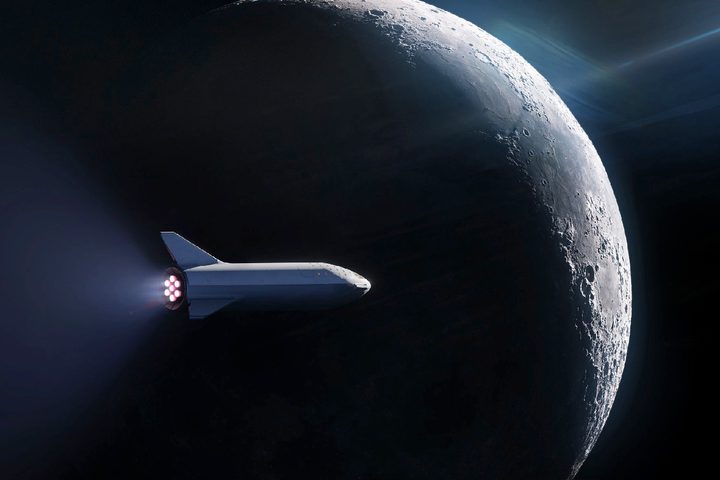
On Monday, September 17, SpaceX is set to announce the name of the mystery passenger who it will launch into orbit around the moon. While the trip is a fly-by, meaning that there will be no actual moon landing, this is still immensely significant. Provided all goes according to plan, this person will become the first lunar traveler since the last U.S. Apollo mission in 1972, and only the 25th person to carry out this feat in human history.

The announcement is being livestreamed, starting at 9 p.m. ET.

Recommended Videos

“SpaceX has signed the world’s first private passenger to fly around the moon aboard our BFR launch vehicle — an important step toward enabling access for everyday people who dream of traveling to space,” the company noted in a recent tweet. “Find out who’s flying and why on Monday, September 17.”

SpaceX CEO Elon Musk has so far failed to reveal anything about the identity of the mystery passenger, other than posting an emoji of the Japanese flag on Twitter last week. Whoever it is, it’s probably safe to assume that they are sufficiently wealthy to spend more money than we’ll see in a lifetime on a (literally) out-of-this-world moon-shot vacation.

While SpaceX will reveal the passenger name, it may not yet be ready to commit to revealing the price of the ticket or the exact date (or, heck, even approximate date) of travel, however. As far as price goes, SpaceX is keeping quiet. Don’t expect any kind of a budget vacation, though. In 2001, multi-millionaire Dennis Tito, the man who became history’s first space tourist, paid $20 million to spend eight days aboard the International Space Station.

In terms of when the launch will take place, things are also in the dark. The biggest clue in this regard is that the launch is set to take place on board the Big Falcon Rocket (BFR), which is thought to be still several years away from being ready for liftoff. The BFR has been described as the most powerful rocket in history.

While this is all definitely exciting, it’s important to display some caution. Last year, Musk said that two unnamed passengers had paid a deposit for a weeklong mission to the moon. Their names were not revealed and this mission has since been postponed.

Luke Dormehl
I'm a UK-based tech writer covering Cool Tech at Digital Trends. I've also written for Fast Company, Wired, the Guardian…
China’s answer to SpaceX’s reusable rockets literally catches boosters in a net
SpaceX catches boosters on legs. China just used a net.
Ammunition, Missile, Weapon

SpaceX's playbook for recovering a rocket booster generally involves legs, a precisely controlled vertical landing, and either a concrete pad or a drone ship. 

China just managed to pull off something similar, but in a slightly different way, and on July 10, it tested the method as well.

Read more
Dimming the sun sounds unhinged, but this new study on El Niño makes a surprisingly good case for it
A natural test case, Australia's worst-ever wildfire season, suggests the idea deserves serious consideration.
Nature, Outdoors, Sky

When I first saw "scientists propose dimming the sun," I rolled my eyes. It sounds like a science fiction movie cooked up after watching many climate documentaries. But a new study, published on July 8, 2026, in the journal Science Advances, seems to have a genuinely compelling argument.

A Super El Niño is currently forming in the Pacific, feared to be the most intense in decades. It could escalate floods, wildfires, and extreme heat events worldwide. However, Researchers at UC San Diego's Scripps Institution of Oceanography, led by climate scientists Kate Ricke and Jessica Wan, are now proposing one of the most interesting solutions I’ve come across.

Read more
You can now walk through space and gaze into a black hole at this VR exhibit
Smithsonian Starstruck lets you drift past dying stars and see the origin point of the universe for as little as $18 a person.
Smithsonian Starstruck featured

Most planetarium shows ask you to sit still and look up. The Smithsonian's new VR exhibit takes a different approach, letting visitors walk through the vast expanse of the universe, drifting past stars, planets, and a black hole to get a physical sense of its true scale.

A $29 ticket to the edge of the galaxy

Read more