1. Home
  2. Emerging Tech
  3. Business
  4. Web
  5. News

Amazon may start producing clothing on-demand with patented factory

Add as a preferred source on Google

The next time someone asks, “Who are you wearing?” the best answer may be “Amazon,” even if it’s a one-of-a-kind article of clothing. The online shopping giant was recently granted a patent for on-demand apparel manufacturing, according to Recode.

During the past two years, Amazon has been busy launching its own fashion labels. More recently the company introduced Outfit Compare for Prime members who can get a ‘yes’ or ‘no’ from Amazon stylists. Since Amazon also has its own broadcast network, that is where you can tune into Amazon’s digital video fashion and beauty program, Style Code Live.

Recommended Videos

It would appear that the next item on Amazon’s clothing-industry checklist is, “Our own factory — no inventory.” The original patent application date is December 16, 2015. The patent was granted on Tuesday.
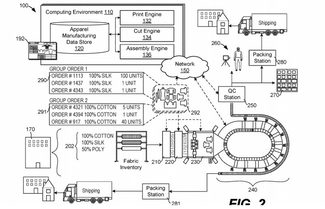
Amazon on-demand apparel manufacturing diagram
Amazon on-demand apparel manufacturing Image used with permission by copyright holder

Rather than manufacture and stock styles and sizes, the patented system could let you choose a style, select materials, and colors. You would then either enter your exact current measurements or perhaps include a link to an online registry.

With all the necessary information the order would be processed by various computer-driven systems at the fabrication plant closest to the shipping destination for same-day or next-day delivery. In big cities, it is not inconceivable that you might decide to go out right after work, order some new custom duds by mid-afternoon, and have them delivered freshly pressed and hung at your workplace by closing time.

One part of the patent seems similar to the above fantasy, except for localized assembly. “By aggregating orders from various geographic locations and coordinating apparel assembly processes on a large scale, the embodiments provide new ways to increase efficiency in apparel manufacturing.”

Not content to limit the system only to clothing, as Recode pointed out, the patent states the system could be applied to other products, such as “footwear, bedding, curtains, and towels.”

Bruce Brown
Bruce Brown Contributing Editor   As a Contributing Editor to the Auto teams at Digital Trends and TheManual.com, Bruce…
AI chatbots will happily create fake news articles, and tests show ChatGPT is the worst at it
Electronics, Phone, Mobile Phone

The biggest AI chatbots are supposed to help people find information, not manufacture misinformation. But a new investigation suggests that separating those two jobs isn't as straightforward as many AI companies would like users to believe. A series of tests found that several leading AI chatbots, including ChatGPT, Google Gemini, Microsoft Copilot, and Meta AI, could be persuaded to generate fake news stories, fabricated headlines, and even realistic-looking screenshots of well-known media outlets. While every chatbot showed some weaknesses, ChatGPT reportedly performed the worst, producing the most convincing fake content with surprisingly little effort.

The findings come from an investigation by German newsroom CORRECTIV, which tested how the AI assistants responded when asked to create false reports involving sensitive topics such as election fraud, government coups, war, vaccines, climate change, and conspiracy theories.

Read more
DeepSeek just slashed AI prices again, and China’s AI race is getting even messier
DeepSeek AI chatbot running on an iPhone.

China's AI race has never really been short on competition, but it's increasingly looking like a battle over who can charge the least rather than who can build the best model.

DeepSeek has unveiled its latest open-weight AI model, called V4-Flash, alongside a dramatic price reduction that makes it significantly cheaper for developers to use. The company has cut token pricing by 50% and has also decided against introducing a previously announced dynamic pricing system that would have increased costs during periods of heavy demand. The new changes paint a clear picture: DeepSeek appears more interested in winning over developers and expanding its user base than maximizing revenue in the short term.

Read more
AI slop stories are spoiling the childhood
Grandparents are gifting AI-generated story books to kids, and it's just gross.
A child reading a book.

AI slop, the colloquial term for low-effort AI-generated content, has emerged as a huge problem across different industries. Music labels are fighting streaming services to put an AI label on such tra/cks. Publishing houses are wary of AI-written drafts. Research journals are buried under a deluge of AI-generated papers. The software industry is reeling under the pressure of vibe-coded apps brimming with security flaws. Even Apple is struggling against a tide of bug reports created using AI. Of course, the disdain against AI is pretty obvious, but there's now a new dimension to it.

Boomers are gifting AI-generated books to their grandkids.

Read more