1. Home
  2. Space
  3. News

See a close-up of the stunning Lagoon Nebula in new Hubble image

Add as a preferred source on Google

The image of the week shared by researchers working with the Hubble Space Telescope this week is a real stunner, showing the open cluster NGC 6530. This cluster of thousands of stars is shrouded in dust and makes up a small part of the huge and beautiful Lagoon Nebula.

Located 4350 light-years away in the constellation of Sagittarius, the distinctive smoke-like shapes of the cluster are formed from a cloud of interstellar dust and gas which is feeding the formation of new stars.
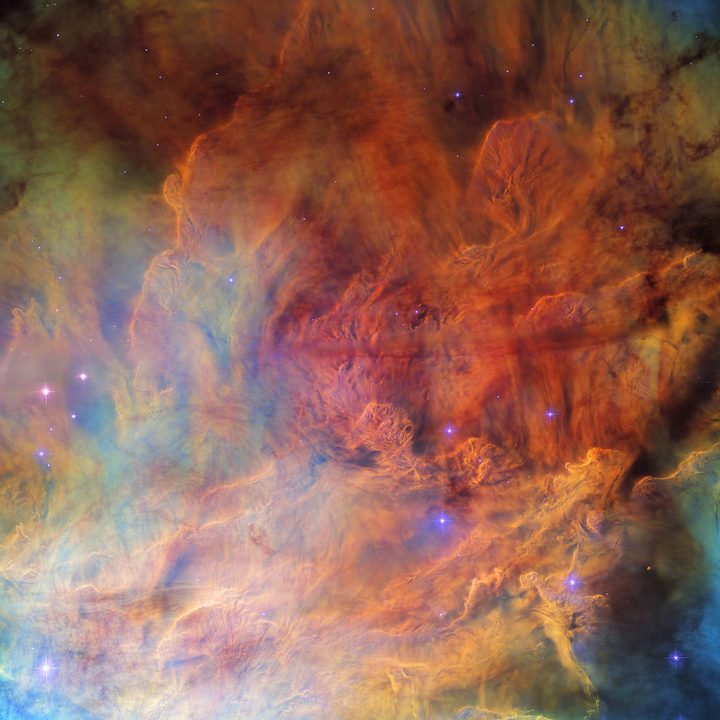
A portion of the open cluster NGC 6530 appears as a roiling wall of smoke studded with stars.
A portion of the open cluster NGC 6530 appears as a roiling wall of smoke studded with stars in this image from the NASA/ESA Hubble Space Telescope. NGC 6530 is a collection of several thousand stars lying around 4,350 light-years from Earth in the constellation Sagittarius. ESA/Hubble & NASA, O. De Marco; Acknowledgment: M.H. Özsaraç

To investigate this scene, Hubble used two of its instruments: the Advanced Camera for Surveys and the Wide Field Planetary Camera 2. Hubble scientists write that astronomers “scoured the region in the hope of finding new examples of proplyds, a particular class of illuminated protoplanetary discs surrounding newborn stars. The vast majority of proplyds have been found in only one region, the nearby Orion Nebula. This makes understanding their origin and lifetimes in other astronomical environments challenging.”

Recommended Videos

This image combines data from the Advanced Camera for Surveys with data from a ground-based instrument, the OmegaCAM on the VLT Survey Telescope which is located in Chile.

Hubble previously imaged the Lagoon Nebula in one of its most famous photos, which was shared to celebrate the telescope’s 28th anniversary. This image also showed just a part of the full nebula, which is an enormous 55 light-years wide and 20 light-years tall.

The nebula is also known as Messier 8 but was named the Lagoon Nebula for its wide dust lane which looks like a lagoon in deep field images. Up close, you can see more details in the dust structures which are blown about and sculpted by the stellar winds in and among the dust, created as new stars are formed.

Georgina Torbet
Georgina has been the space writer at Digital Trends space writer for six years, covering human space exploration, planetary…
China’s answer to SpaceX’s reusable rockets literally catches boosters in a net
SpaceX catches boosters on legs. China just used a net.
Ammunition, Missile, Weapon

SpaceX's playbook for recovering a rocket booster generally involves legs, a precisely controlled vertical landing, and either a concrete pad or a drone ship. 

China just managed to pull off something similar, but in a slightly different way, and on July 10, it tested the method as well.

Read more
Dimming the sun sounds unhinged, but this new study on El Niño makes a surprisingly good case for it
A natural test case, Australia's worst-ever wildfire season, suggests the idea deserves serious consideration.
Nature, Outdoors, Sky

When I first saw "scientists propose dimming the sun," I rolled my eyes. It sounds like a science fiction movie cooked up after watching many climate documentaries. But a new study, published on July 8, 2026, in the journal Science Advances, seems to have a genuinely compelling argument.

A Super El Niño is currently forming in the Pacific, feared to be the most intense in decades. It could escalate floods, wildfires, and extreme heat events worldwide. However, Researchers at UC San Diego's Scripps Institution of Oceanography, led by climate scientists Kate Ricke and Jessica Wan, are now proposing one of the most interesting solutions I’ve come across.

Read more
You can now walk through space and gaze into a black hole at this VR exhibit
Smithsonian Starstruck lets you drift past dying stars and see the origin point of the universe for as little as $18 a person.
Smithsonian Starstruck featured

Most planetarium shows ask you to sit still and look up. The Smithsonian's new VR exhibit takes a different approach, letting visitors walk through the vast expanse of the universe, drifting past stars, planets, and a black hole to get a physical sense of its true scale.

A $29 ticket to the edge of the galaxy

Read more