1. Home
  2. Space
  3. News

Hubble is investigating mysterious ‘spokes’ in Saturn’s rings

Add as a preferred source on Google

Saturn is famous for its beautiful rings, but these rings have a strange feature: “spokes” which appear intermittently. These spots in the rings can be light or dark and can look like blobs or like lines stretching radially outward from the planet, and they appear in a regular cycle related to the planet’s equinox. Now, the Hubble Space Telescope has the opportunity to study these oddities of the rings in more detail and researchers hope they can learn more about what causes these features.
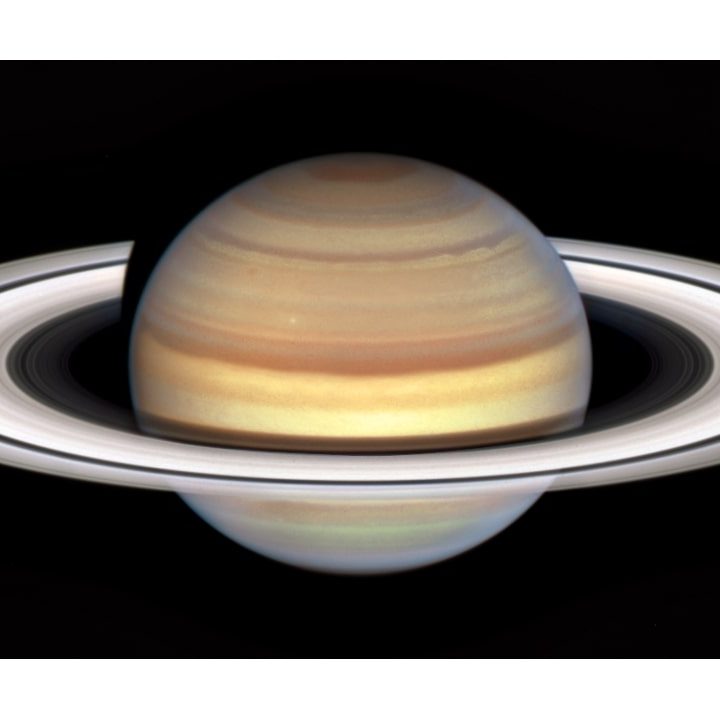
Saturn in its "spoke season" with the appearance of two smudgy spokes in the B ring, on the left in the image.
NASA’s Hubble Space Telescope has observation time devoted to Saturn each year, thanks to the Outer Planet Atmospheres Legacy (OPAL) program, and the dynamic gas giant planet always shows us something new. This latest image heralds the start of Saturn’s “spoke season” with the appearance of two smudgy spokes in the B ring, on the left in the image. NASA, ESA, Amy Simon (NASA-GSFC) IMAGE PROCESSING: Alyssa Pagan (STScI)

The spokes were first noticed by the Voyager mission which passed in the 1980s, and since then they have been seen just before and after the equinox: the time at which day and night are of equal length across the planet because the sun is directly over the equator. On Earth, we experience two equinoxes each year, and the same is true for Saturn — but because Saturn is further out in its orbit and its year is much longer, its equinoxes occur just once every 15 Earth years.

Recommended Videos

Saturn’s next autumnal equinox is coming up on May 2025, so researchers are using Hubble to observe the planet and its rings at this key time. “Thanks to Hubble’s OPAL program, which is building an archive of data on the outer solar system planets, we will have longer dedicated time to study Saturn’s spokes this season than ever before,” said Amy Simon, head of the Hubble Outer Planet Atmospheres Legacy (OPAL) program, in a statement.

That’s good news because although the researchers know they’ll see spokes around this time, they don’t know exactly when they will start appearing.

“Despite years of excellent observations by the Cassini mission, the precise beginning and duration of the spoke season is still unpredictable, rather like predicting the first storm during hurricane season,” Simon explained.

The spokes are currently visible as two grey smudges within the rings to the left of the planet in the image above, and though these may fade the researchers expect to see more in the coming months.

The current theory of the spokes’ origin is that they are related to Saturn’s magnetic field, as charged particles from the sun interact with it in a way that could charge particles within the rings, shifting these particles out of place with the rest of the ring structure. But astronomers need to do more research to be sure of this theory — and to find out whether similar spokes could occur on other planets with rings, such as Neptune or Jupiter.

“It’s a fascinating magic trick of nature we only see on Saturn —for now at least,” Simon said.

Georgina Torbet
Georgina has been the space writer at Digital Trends space writer for six years, covering human space exploration, planetary…
China’s answer to SpaceX’s reusable rockets literally catches boosters in a net
SpaceX catches boosters on legs. China just used a net.
Ammunition, Missile, Weapon

SpaceX's playbook for recovering a rocket booster generally involves legs, a precisely controlled vertical landing, and either a concrete pad or a drone ship. 

China just managed to pull off something similar, but in a slightly different way, and on July 10, it tested the method as well.

Read more
Dimming the sun sounds unhinged, but this new study on El Niño makes a surprisingly good case for it
A natural test case, Australia's worst-ever wildfire season, suggests the idea deserves serious consideration.
Nature, Outdoors, Sky

When I first saw "scientists propose dimming the sun," I rolled my eyes. It sounds like a science fiction movie cooked up after watching many climate documentaries. But a new study, published on July 8, 2026, in the journal Science Advances, seems to have a genuinely compelling argument.

A Super El Niño is currently forming in the Pacific, feared to be the most intense in decades. It could escalate floods, wildfires, and extreme heat events worldwide. However, Researchers at UC San Diego's Scripps Institution of Oceanography, led by climate scientists Kate Ricke and Jessica Wan, are now proposing one of the most interesting solutions I’ve come across.

Read more
You can now walk through space and gaze into a black hole at this VR exhibit
Smithsonian Starstruck lets you drift past dying stars and see the origin point of the universe for as little as $18 a person.
Smithsonian Starstruck featured

Most planetarium shows ask you to sit still and look up. The Smithsonian's new VR exhibit takes a different approach, letting visitors walk through the vast expanse of the universe, drifting past stars, planets, and a black hole to get a physical sense of its true scale.

A $29 ticket to the edge of the galaxy

Read more