It was the shot heard around the world: “Sega does what Nintendon’t.”
In the late 1980s, Nintendo was on top of the world. Atari’s star was falling and mascots like Mario were catapulting the Japanese studio to stardom. Nintendo was becoming synonymous with video games, herding players to one plastic box during gaming’s early Wild West days. Competing with a Nintendo system was no easy task. It wouldn’t just require a better system, but a fierce message that would stick with players.
That’s exactly what Sega pulled off in 1989 when it brought its 16-bit Mega Drive to North America on August 14, 1989, with a new name: the Sega Genesis. Thirty-five years later, that name stands as a symbolic one. The Genesis wasn’t just the birthplace of Sonic the Hedgehog and Sega’s overall legacy; it created the modern video game console war as we know it. Though Sega has long since lost the battle it started, its impact can still be felt today, making the Genesis one of the most consequential systems in history.
Starting a war
In 2024, the Sega Genesis is a well-regarded system — and for good reason. Sega’s NES was a powerful system for the time that showed off the power of 16-bit visuals. It did that with a deep roster of games. I still regularly uncover gems from the era to this day (Nintendo Switch Online’s Sega Genesis catalog is especially great for unearthing surprises). Sonic the Hedgehog showed how fast video games could be, while Ecco the Dolphin sold how transportive digital adventures could be. It was a weird and wonderful expansion of the medium that paved the way for a more creative industry.
More crucially, it created a more heated one. too.
When it came to marketing the Genesis, Sega knew that it couldn’t afford to play nice. Nintendo seemed unreachable, like Donkey Kong sitting atop his mountain of girders. It wouldn’t be enough to simply drop another console into a crowded marketplace. The Genesis would need to make a name for itself. So, like a new prisoner taking a swing at the biggest dog in the yard, Sega went for blood.
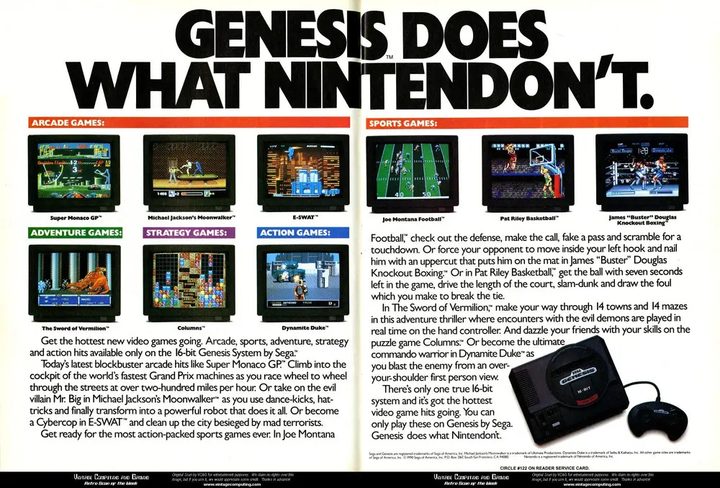
The Genesis’ ad campaign is just as memorable as the console itself. Under the direction of Michael Katz — and boosted by a whole lot of ad dollars — Sega rolled out an unusually aggressive ad campaign to build the Genesis’ brand. Gamers opened their favorite magazines to find a two-page spread that proclaimed, “Genesis does what Nintendon’t.” It felt like Sega breaking the fourth wall. Gaming companies loved to imply they were better than the rest, but actually calling out the competition by name was bold — especially a goliath like Nintendo.
That decision paid off. Sega quickly built the Genesis as a sort of counterculture platform. While Nintendo had a reputation as a kid-friendly console filled with happy-go-lucky mascots, Sega painted itself as a bad boy. The company, and its characters, had attitude. Sonic the Hedgehog looked like a cooler hero next to Mario, while games like Earthworm Jim courted older teens with their gross-out humor.
Opening the floodgates
The Genesis was a brief win for Sega, but it opened the floodgates. One could argue that we wouldn’t have PlayStation and Xbox today without Sega architecting a competitive strategy that allowed multiple platform holders to exist at once. Though more importantly, Sega inadvertently engineered something much more sinister: the dreaded console war. The effective ad campaign for the Genesis raised an entire generation of kids willing go to war for their console of choice. While enthusiasts would always argue about which home computer was better, Sega made it personal. If you owned an NES, you were lame; Genesis owners were cool.
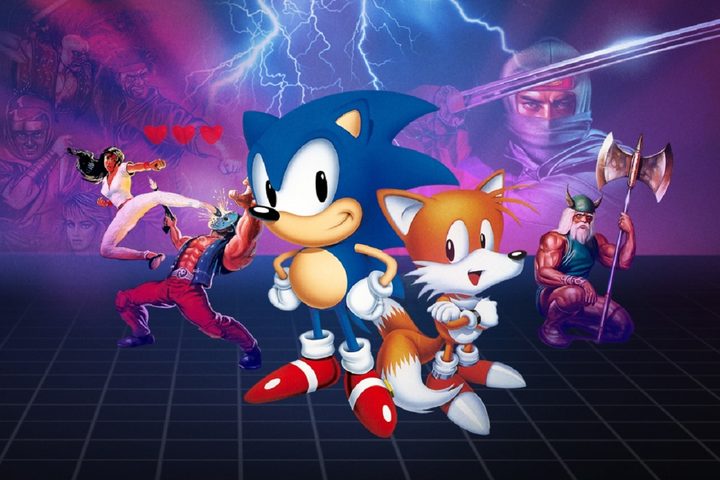
That attitude has snowballed in the 35 years since the Genesis’ release. Video game consoles have now become replacements for personalities in a certain subset of gamers. We’re forced to endure heated arguments between “Xbots and Sony Ponies” who are desperate to knock one another down a peg. The “big three” platform holders once played into that dynamic, but they’ve since cooled their messaging. Nintendo has defected from the war completely, while Xbox and Sony are both more open to bringing their games to their competitors’ systems. Still, that hasn’t stopped fans from clinging to their arms and carrying on the battle .
While today’s eye-rolling online fighting can be traced back to the Sega Genesis, the reality is that we likely still would have gotten here even without it. We’re currently living in the era of “us vs. them.” Everything is a culture war where combatants on each side see themselves as loyal soldiers. It’s in gaming, movies, politics, and nonsensical social debates that have poisoned our culture. Maybe it’s just in our nature to fight. Sega just figured out how to weaponize that for gamers before anyone else.
At least we got Sonic the Hedgehog out of it. That seems like a fair trade.