
Detailed within a post on Google+ recently and now active on the Glass store, Google has reopened Google Glass sales in the United States while supplies last, and provided you have $1500 in your pocket. Google originally opened up Google Glass sales to the public for a special one-day sale during mid-April 2014 and eventually had to shut the store down due to demand. However, Google didn’t specify how many pairs of the glasses were actually sold during the one-day event. According to a Google representative, inventory of the glasses have been built back up since that sale and the store will continue to stay open until all pairs are sold.
Despite the accessibility of the hardware, Google still considers Glass to be in an open beta testing period for U.S. residents. Interestingly, it appears as if Google is attempting to demonstrate the product out in public as well. Over the weekend, Google set up an outdoor booth at the Players Championship PGA event in Ponte Vedra Beach, Florida. Pairs were being sold for the same price, $1,500, and sales were reported to be “better than expected.“
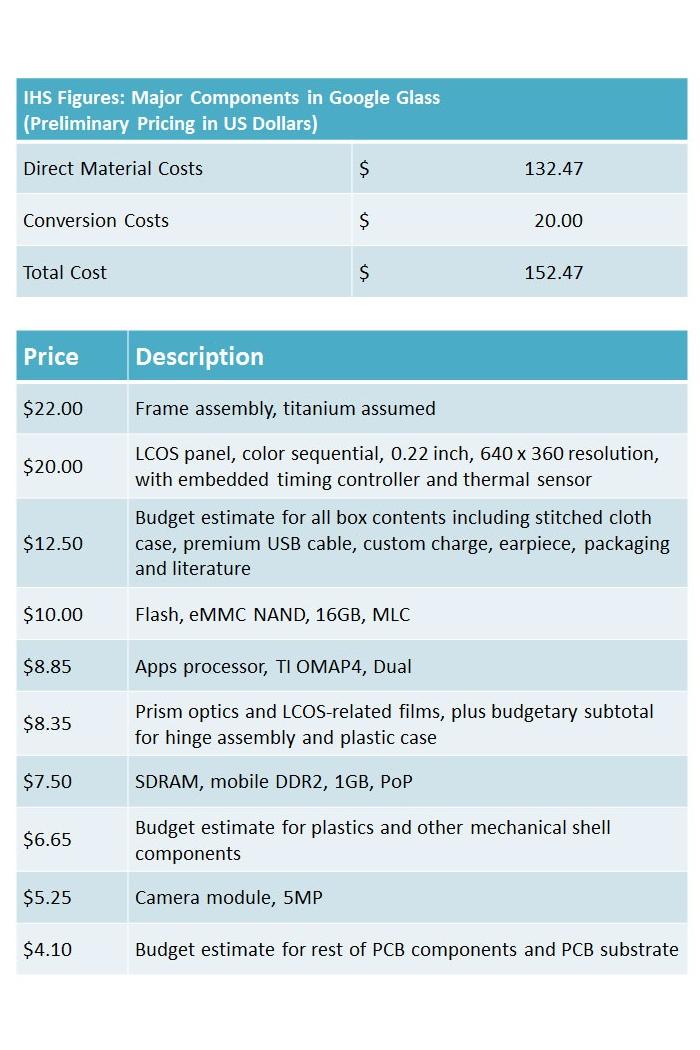 In a related story, research firm IFS Technology released a report today that broke down the manufacturing cost of the device. The firm’s Teardown Analysis team estimates the cost of the hardware and manufacturing to be $152.47 for each pair, approximately one tenth of the price that Google is selling the device.
This figure is fairly close to an estimation provided by another firm called TechInsight. That research team estimated that the hardware and manufacturing cost even less at just $79.78 per pair.
However, that’s not the only cost that should be accounted for when creating a price point for a product. Speaking about the findings, IFS senior director Andrew Rassweiler said “As in any new product—especially a device that breaks new technological ground—the bill of materials (BOM) cost of Glass represent only a portion of the actual value of the system.”
Rassweiler continued “IHS has noted this before in other electronic devices, but this is most dramatically illustrated in Google Glass, where the vast majority of its cost is tied up in non-material costs that include non-recurring engineering (NRE) expenses, extensive software and platform development, as well as tooling costs and other upfront outlays. When you buy Google Glass for $1,500, you are getting far, far more than just $152.47 in parts and manufacturing.“
A Google spokesperson was quick to refute the estimated build cost from IFS Technology and said “While we appreciate another attempt to estimate the cost of Glass, this latest one from IHS, like Teardown.com’s, is wildly off. Glass costs significantly more to produce.”
Of course, Google will have to reduce the cost of Glass significantly if the company wants to successfully sell the hardware through retailers like Best Buy and Amazon at some point in the next couple years. Google is also faced with the challenge of educating the consumer when it comes to marketing Glass. According to the results of a recent study, nearly 70 percent of Americans will avoid wearing Glass in public due to perceived privacy issues.


