Internet giant Google is getting into the music business, integrating a new music search feature directly into its primary Web search capabilities. Now, searching for song titles, artists, albums, and even bits of lyrics will turn up audio previews of matching songs—along with links to purchase the song. And for folks who don’t quite know exactly what they’re looking for, Google will also display links that can help users discover music related to their queries.
To pull off the service, Google has partnered with Lala and iLike (which was recently acquired by MySpace) to provide previews and purchasing links; music suggested are provided by Pandora, iMeem, and Rhapsody.
“This feature doesn’t just make search better,” Google wrote in its corporate blog post authored by Murali Viswanathan, Product Manager and Ganesh Ramanarayanan, Software Engineer. “It also helps people discover new sources of licensed music online while helping artists to discover new generations of fans and reconnect with longtime listeners. Our users love music, and this tool introduces millions of music seekers in the U.S. to a new generation of licensed online music services.”
Google is rolling out the feature now, it said, and it should be available to U.S. users within a day or two, the company wrote: “We’ll be rolling this feature out gradually to users across the U.S. over the next day. To learn more, check out this page or watch the video below.”
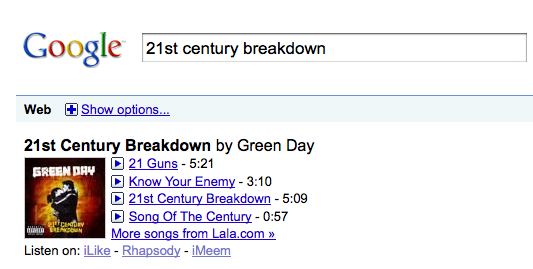
By adding a music search capability, Google is increasing its appeal to the music industry, which has been struggling to shift from physical distribution models to online distribution. However, Google is not working directly with record labels or music distributors—instead, it’s letting partners like Lala, Rhapsody, and Pandora interface with the labels while Google just provides hooks into content from those services.
The appeal to the music industry is being able to put their content in front of billions of Google search users; the appeal to Google is (of course) advertising revenue based on being a gateway to music, although any financial terms of its partnerships with digital music companies haven’t been disclosed.