1. Home
  2. Space
  3. Emerging Tech
  4. News

Juno performs longest-ever propulsive maneuver in a race against the sun

Add as a preferred source on Google

NASA’s Juno mission, launched in 2011, has collected a wealth of information about Jupiter since it arrived in 2016. It has discovered unexpectedly storm-free poles, learned about the planet’s complex weather system, observed bizarre geometric storms, and captured some truly beautiful images. And this week the craft it pulled off a feat of precision engineering, performing its longest propulsive maneuver in a race against the setting sun.

The dramatic intervention was necessary because, like many spacecraft, Juno is solar powered. The mission was originally intended to end in 2018, but the craft entered a different orbit than planned, so its mission was extended to 2021. This extra time put the craft at risk of being trapped by an eclipse, as on its previous path it would have had to spend 12 hours in transit across the planet’s shadow with any direct sunlight. That would have drained its batteries completely and ended the mission.
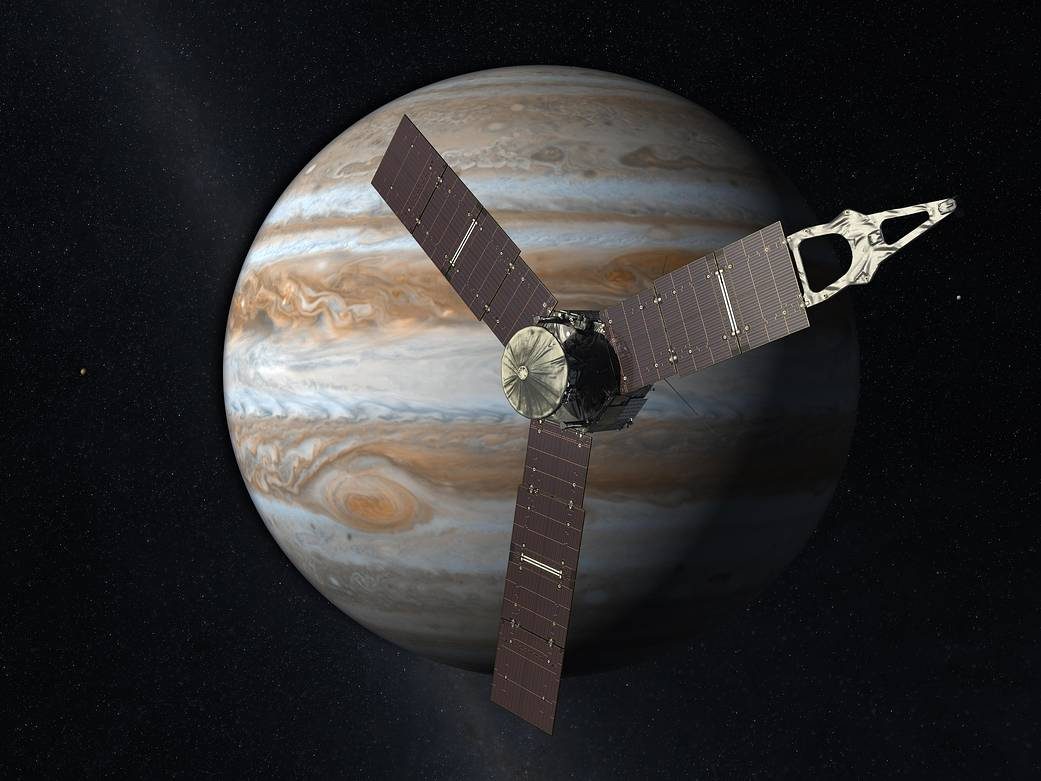
This illustration depicts Juno in an elliptical, polar orbit around Jupiter. NASA

So the NASA researchers came up with a solution to change the orbital velocity of the craft by 126 mph using its reaction-control thrusters. The maneuver lasted for 10.5 hours, which is five times longer than the system had been used for before. It used up 160 pounds of fuel and allowed the craft to avoid the deadly shadow that was chasing it down.

Recommended Videos

“With the success of this burn, we are on track to jump the shadow on November 3,” Juno’s principal investigator, Scott Bolton of the Southwest Research Institute, said in a statement. “Jumping over the shadow was an amazingly creative solution to what seemed like a fatal geometry. Eclipses are generally not friends of solar-powered spacecraft. Now instead of worrying about freezing to death, I am looking forward to the next science discovery that Jupiter has in store for Juno.”

These kinds of creative adjustments are necessary due to the inherent uncertainties of space exploration, according to the researchers. “Pre-launch mission planning did not anticipate a lengthy eclipse that would plunge our solar-powered spacecraft into darkness,” Ed Hirst, Juno project manager at NASA’s Jet Propulsion Laboratory, explained in the statement. “That we could plan and execute the necessary maneuver while operating in Jupiter’s orbit is a testament to the ingenuity and skill of our team, along with the extraordinary capability and versatility of our spacecraft.”

Georgina Torbet
Georgina has been the space writer at Digital Trends space writer for six years, covering human space exploration, planetary…
Space is becoming Bezos and Musk’s next data center site, and we have every reason to worry
The AI boom is coming for the night sky
How Vast's space station will look in orbit.

AI data centers already consume vast amounts of electricity and water on Earth, so Silicon Valley has begun looking somewhere considerably more spacious... literally.

Elon Musk's SpaceX and Jeff Bezos' Blue Origin, along with several other companies, have proposed enormous constellations of satellites designed to operate as orbital data centers. However, environmental groups and former space officials are now warning that putting them into orbit at the proposed scale could have severe consequences for Earth's atmosphere and the night sky.

Read more
The first possible exomoon is here, and it makes our Moon look hilariously tiny
Scientists may have found the first exomoon, except this one is the size of Jupiter
This artist’s concept depicts a potential volcanic moon between the exoplanet WASP-49 b, left, and its parent star. New evidence indicating that a massive sodium cloud observed near WASP-49 b is produced by neither the planet nor the star has prompted researchers to ask if its origin could be an exomoon.

We have already discovered more than 6,000 planets outside of our immediate neighborhood. Yet, finding a moon orbiting one of those distant worlds has proved considerably harder. Astronomers may finally have something close to the real deal, but this particular object stretches the word “moon” almost beyond recognition.

Using the European Southern Observatory’s Very Large Telescope in Chile, researchers detected strong evidence for a moon-like object in the CD-35 2722 system. Further observations are still necessary to confirm the discovery, but it could become the first confidently detected natural satellite outside our solar system. There is still one tiny complication though. This moon is apparently massive.

Read more
China’s answer to SpaceX’s reusable rockets literally catches boosters in a net
SpaceX catches boosters on legs. China just used a net.
Ammunition, Missile, Weapon

SpaceX's playbook for recovering a rocket booster generally involves legs, a precisely controlled vertical landing, and either a concrete pad or a drone ship. 

China just managed to pull off something similar, but in a slightly different way, and on July 10, it tested the method as well.

Read more