
  1. Home
  2. Emerging Tech
  3. News

Super telescope captures supermassive black holes forming billions of years ago

Add as a preferred source on Google

The 8.2m Subaru Telescope located at the Mauna Kea Observatory on Hawaii. National Astronomical Observatory of Japan (NAOJ)

An enormous camera mounted to the massive 8.2m Subaru Telescope in Hawaii has captured evidence of supermassive black holes forming in the ancient universe. Astronomers have discovered 83 quasars powered by supermassive black holes from billions of years ago, in the first 10 percent of the universe’s current age.

Recommended Videos

It came as a surprise to scientists that black holes were so common in the earliest days of the universe. “It is remarkable that such massive dense objects were able to form so soon after the Big Bang,” Michael Strauss, a professor of astrophysical sciences at Princeton University and one of the co-authors of the study, said in a statement. “Understanding how black holes can form in the early universe, and just how common they are, is a challenge for our cosmological models.”

The data was collected by looking at very distant objects which are around 13 billion light-years away from Earth. Because it takes time for light to travel this enormous distance, observing quasars this far away is like looking back in time 13 billion years. The Big Bang took place 13.8 billion years ago, so these observations show how the universe appeared in its infancy.

To see quasars at this distance, a tremendously powerful telescope was required. The Subaru Telescope is equipped with an instrument called the Hyper Suprime-Cam (HSC) which has an huge field of view of 1.77 degrees across, which is seven times the area of the full moon. For reference, the Hubble Telescope has a field of view of just 0.04 degrees, meaning many separate images have to be stitched together to form the beautiful pictures we all love to see.
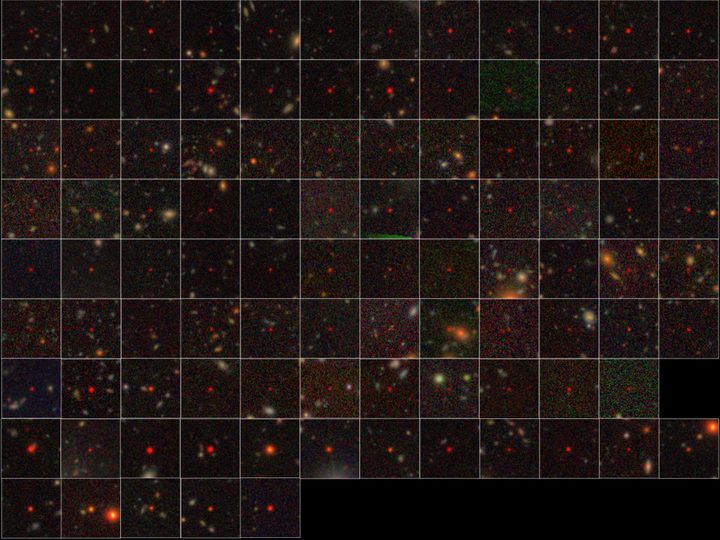
Set of 100 quasars identified from HSC data. The top seven rows show the 83 newly discovered quasars while the bottom two rows represent 17 previously known quasars in the survey area. National Astronomical Observatory of Japan

Using the HSC, the researchers were able to determine that between the 83 newly-discovered quasars and the 17 which had already been discovered in the survey region, there was approximately one supermassive black hole per cubic giga-light-year. That means if you chopped up the universe into cubes which were a billion light years on each side, then you’d expect to find one supermassive black hole per chunk.

The team’s next aim is to hunt for more black holes and to hopefully discover when the very first supermassive black hole appeared in our universe.

Georgina Torbet
Georgina has been the space writer at Digital Trends space writer for six years, covering human space exploration, planetary…
Microsoft wants AI to catch hackers before they even attack
Red team, blue team, green team: Microsoft just gave its AI a full security squad.
Microsoft Project Perception

With AI now capable of writing exploits and running attacks at machine speed, the security tools built for a slower, human-paced world are starting to show their age. Microsoft thinks it has the answer, and it's calling it Project Perception.

So what exactly is Project Perception?

Read more
Nike’s new slide is basically a spa day for your feet
Nike and Hyperice built a slide that literally heats up and vibrates your feet back to life.
nike-air-zoom-hyperslide

Nike just teamed up with Hyperice again, and this time they've built something that feels more like a wellness gadget than a shoe. Meet the Nike Air Zoom Hyperslide, a slide that not only cushions your feet but also heats and vibrates them back to life. It's made less for lounging by the pool and more for helping you recover after training, travel, or just a long day spent standing around.

What is the Nike Hyperslide?

Read more
That Claude chat you shared? Google may have seen it too
Public chat links were indexed by Google, potentially exposing sensitive information shared with the AI.
Claude AI on an iPhone.

If you've ever shared a Claude conversation using a public link, it might be worth checking your privacy settings. Over the weekend, users discovered that publicly shared Claude chats and Artifacts were appearing in Google Search and other search engines through queries such as site:claude.ai/share. The indexed pages reportedly included everything from resumes and business documents to API keys, health information, and other sensitive conversations that users likely never expected to become searchable.

How did this happen?

Read more