1. Home
  2. Space
  3. News

‘Closest black hole’ isn’t actually a black hole, but a stellar vampire

Add as a preferred source on Google

In 2020, astronomers announced they had found the closest black hole ever, located just 1,000 light-years away. However, recent research suggests that the object in question is not actually a black hole, but is rather a rare form of two-star “vampire” system.

The system, called HR 6819, was originally thought to be a three system, with two stars orbiting a black hole — one star near to the black hole and the other much further away. But other researchers suggested a different interpretation of the data, with two stars orbiting each other and no black hole, where one of the stars was “stripped” down to a much lower mass.
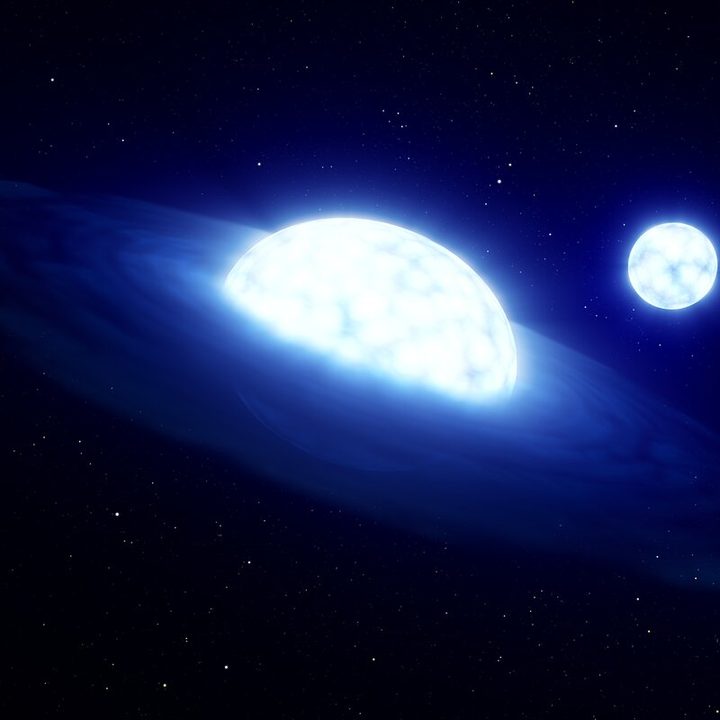
This artist’s of an oblate star with a disc around it and B-type star that has been stripped of its atmosphere (background).
New research using data from ESO’s Very Large Telescope and Very Large Telescope Interferometer has revealed that HR 6819, previously believed to be a triple system with a black hole, is in fact a system of two stars with no black hole. This artist’s impression shows what the system might look like; it’s composed of an oblate star with a disc around it (a “vampire” star; foreground) and a B-type star that has been stripped of its atmosphere (background). ESO/L. Calçada

The two teams of researchers, both those who made the original finding and those who proposed the alternative theory, joined forces to research the possibilities. New data gathered using the European Southern Observatory (ESO)’s Very Large Telescope shows that there are two stars orbiting each other closely, supporting the idea of a stripped star. “These data proved to be the final piece of the puzzle, and allowed us to conclude that HR 6819 is a binary system with no black hole,” said lead researcher Abigail Frost in a statement.

Recommended Videos

“Our best interpretation so far is that we caught this binary system in a moment shortly after one of the stars had sucked the atmosphere off its companion star. This is a common phenomenon in close binary systems, sometimes referred to as ‘stellar vampirism’ in the press,” explained Julia Bodensteiner, co-author of the new study. “While the donor star was stripped of some of its material, the recipient star began to spin more rapidly.”

Even though the system turns out not to host a black hole, it is an exciting finding all the same as it gives researchers a chance to study this stellar vampirism at a crucial time. “Catching such a post-interaction phase is extremely difficult as it is so short,” said Frost. “This makes our findings for HR 6819 very exciting, as it presents a perfect candidate to study how this vampirism affects the evolution of massive stars, and in turn the formation of their associated phenomena including gravitational waves and violent supernova explosions.”

Georgina Torbet
Georgina has been the space writer at Digital Trends space writer for six years, covering human space exploration, planetary…
SpaceX Starship reaches orbit for the first time but its historic flight ends early
Starship reaches orbit for the first time and deploys 26 Starlink satellites before an early splashdown.
spacex-starship

After 13 suborbital test flights and more than $15 billion in development costs, SpaceX's Starship has finally reached orbit. The 407-foot megarocket, the most powerful ever built, lifted off from Starbase, Texas, on Monday and delivered its first real payload on it's 14th attempt. The celebration came with an asterisk, though, since SpaceX had to cut the planned 10-hour mission to roughly three hours.

https://twitter.com/SpaceX/status/2104601695711904180

Read more
Starship is finally going orbital, and SpaceX has picked September 22
Flight 14 is aiming for orbit, Starlink V3 deployment and a very long day in space.
Starship rocket.

SpaceX is finally ready to give Starship its biggest test yet. The company says the massive rocket's 14th test flight is scheduled for September 22, when it will attempt to put the upper stage into Earth orbit for the first time. The launch is currently pending regulatory approval, with a 75-minute window opening at 7:15 a.m. CT.

Starship has 26 Starlink satellites to deliver

Read more
Want a city on the Moon? Scientists say there’s not enough water
A billion tons still comes up short
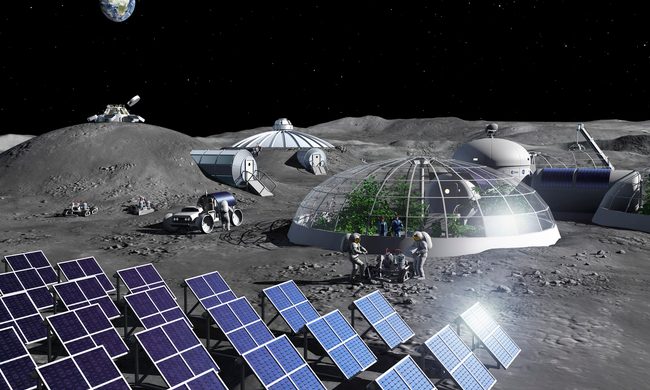
Artist impression of activities in a Moon Base.

For decades, humanity has looked up at the Moon and wondered what it would be like to live on it. Think sprawling cities, factories, research centers, and permanent human settlements. Unfortunately, there is one fairly fundamental problem with that vision.

A new study published in Frontiers in Space Technologies argues that even the Moon's potentially enormous reserves of frozen water may be nowhere near enough to support city-sized populations sustainably. Researchers Martin Elvis and Jonathan McDowell estimate that the permanently shadowed regions near the lunar poles could contain roughly one billion tons of water. It sounds like an extraordinary amount until you put a million thirsty humans next to it.

Read more