  1. Home
  2. Phones
  3. Android
  4. Business
  5. Mobile
  6. News

Google I/O: Android Q aims to bring app permissions firmly under control

Add as a preferred source on Google
Image used with permission by copyright holder

Google is capitalizing on Google I/O 2019 to detail how it intends to make Android app permissions and security better in Android Q, which will, in turn, make your smartphone a safer, more secure place for your data.

The biggest change to Android Q’s permissions is the addition of a more targeted system. At the moment, granting a permission in Android is an analog process — you either grant an app storage permission or you don’t. While that makes everything nice and simple, it means that there are no limits on the app where timing is concerned.

Recommended Videos

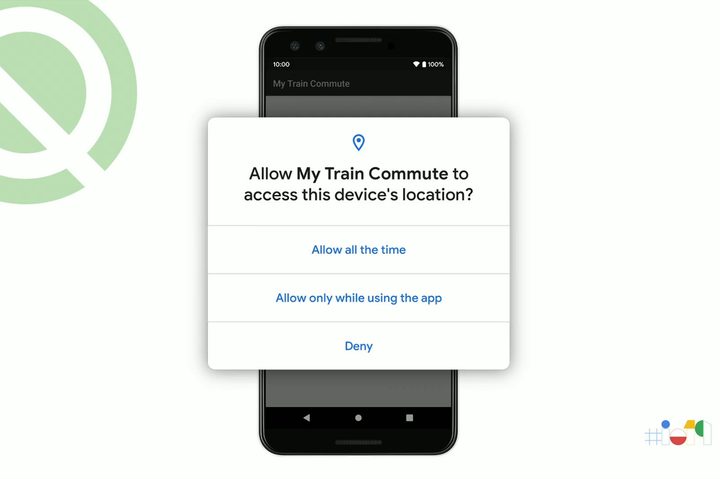
In Android Q, you’ll be able to specify that you only want to grant an app permission to access your location data while you’re using that specific app. This means a chat app will no longer be able to access your location data while it’s not being used, but you’ll still be able to send your location to your friend when you need to.

Adding new options to permissions is only the beginning. Google is also asking app developers to find ways around permissions if they don’t need to be used — for instance, by using “Retreiver APIs” to pull relevant data, instead of granting blanket permissions that make users suspicious. Google highlighted how SMS Retrieval APIs can be used to confirm text message confirmation codes without the need to ask for SMS permissions.

There are times when permissions are absolutely required, and Google is also asking developers to make the reasons behind permissions more apparent. Only 18% of Android users allow apps all the permissions they request, and the top reason for denial is that the “app shouldn’t need the permission.” In those cases, it’s on the app developer to explain why it is their app needs these permissions.

Android Q will also be locking down some of your device’s individual indentifiers, including the IMEI, ESN, Build, SIM, and USB numbers. These hardware identifiers used to be available through certain permissions. An Android Q device’s MAC address is also completely randomized when connecting to a different network. Changing the way these elements of Android work significantly boosts user security.

Mark Jansen
Former Mobile Evergreen Editor
Mark Jansen is an avid follower of everything that beeps, bloops, or makes pretty lights. He has a degree in Ancient &…
Samsung may finally give the Galaxy S27 Ultra a meaningful battery boost using silicon-carbon tech
Galaxy S27 Ultra could reach 5,700mAh as Samsung explores silicon-carbon batteries
Electronics, Phone, Mobile Phone

Samsung was already rumored to be preparing a larger battery for the Galaxy S27 Ultra, while the upcoming Galaxy S27 Pro was expected to carry a 5,000mAh cell. At the time, however, there was no indication that silicon-carbon batteries were also in the works.

Samsung recently introduced the technology on the Galaxy Z Fold 8 series. A new GalaxyClub report has now revealed the alleged battery capacities of both phones, and they could represent significant upgrades by Samsung’s standards.

Read more
Spotify meets Snap Map in Snapchat’s latest update
The new Now Playing feature adds real-time music sharing with customizable privacy controls.
Now Playing on Snap Map Spotify Snapchat featured

Snapchat is giving Snap Map a musical makeover. The company has announced Now Playing, a new feature that lets users share the music they're listening to in real time directly on Snap Map. Launching first with Spotify, the integration allows friends to discover each other's favorite tracks, save songs, and jump straight into Spotify without leaving Snapchat. The feature is rolling out now in regions where both Snapchat and Spotify are available, with Canada set to receive it soon.

How Now Playing works

Read more
OnePlus is building another flagship monster for a shrinking audience, and its expected to launch in October
OnePlus 16 could launch in October, but it may not leave China
Rear shell of OnePlus 15.

While OnePlus may have exited the US and Europe, the brand is still alive in its home market and is already working on its next flagship smartphone. A fresh leak from Chinese tipster Digital Chat Station has now revealed more details about the OnePlus 16, including its design and a revised launch timeline.

The tipster previously claimed that the phone would arrive in September 2026, but the latest information points to an October launch in China (via Gizmochina). The global picture is far less clear, and there is now even some doubt over whether the OnePlus 16 will make it to India, which remains the company’s biggest market.

Read more