As you’ve likely heard, Apple has released two new iPhones… and one of them is the much-coveted gold iPhone 5S. There’s been much derision over the gaudy device, and while plenty of jokes are being made at its expense, apparently fanboys and girls out there are snagging it up because it’s in short supply for launch day.
But who exactly is buying the gold iPhone? You know you’re going to get some hell for it, but your “IDGAF” attitude has taken over and the precious must be yours. So after some Twitter investigation, we found out who you are. These are the four types of people who have bought or will buy the gold iPhone.
1. Spoiled teens (and very likely their spineless parents)
A quick Google search reveals what we already know: The youngins are iPhone-crazy and will do whatever it takes to get the latest one. And of course, “whatever it takes” involves hounding mom and dad to get the gadget for them, and depending on how much moolah they have (or how often they equate love with getting their kids what they want), they often give in.
Yess mom and dad said yes to getting me the gold iPhone 5s for my birthday and they got me a Michael Kors bag and new watch for my birthday
— demi miles (@Demimilesxo) September 13, 2013
mom just said she would take my phone so I can use her upgrade to get the gold iPhone 5s. best mom award
— erin hearty ♔ (@erinnpamela) September 12, 2013
“@the_lalalaine: told my dad i should get the new gold iphone cause im a boss ass bitch”
— Hannah Hicks (@hannnnahhickss) September 13, 2013
I already told my parents they getting me the gold iPhone, if i dont I will break this one so they have to get it for me.
— khayla✨ (@ImKaylaa_) September 10, 2013
2. Flashy executives
If you’re boss man of a tech company in Silicon Valley, you’re most likely one of the first few folks to get your hands on the gold iPhone. In fact, you may even have one now (or know someone who does):
@griffintech We actually some an exec in Cupertino walking- talking on a gold iPhone last week
— Diana Stancil (@DianaStancil) September 10, 2013
If you’ve got boatloads of money to burn, you probably would go all out and go for the real thing – an iPhone literally covered in gold:
The REAL gold £3k iPhones made by Glasgow bizman. Order of 53 from Nigerian govt. I phoned him: http://t.co/BfJS2uYzU3 via @independent
— Simon Usborne (@susborne) September 10, 2013
Seems boss of @goldandco got carried away. He now tells me a Nigerian individual – not the govt. – ordered 53 anniversary gold iPhones.
— Simon Usborne (@susborne) September 11, 2013
3. Um… gay guys?
Twitter is unfortunately teeming with bigots who don’t think real men would buy the gold iPhone (but will willingly get it in silver or space gray because, you know, manliness).
Apple just emailed me…that gold iphone look gay as fuck…ima rock with the silver one tho it look clean.
— Childish King Breeze (@BreezeBeDrawlin) September 13, 2013
Sorry girl. But I’m pretty sure if your boyfriend buys a gold iPhone, he’s probably calling his boyfriend on it.
— Danielle Fernandez (@mydanimarie) September 11, 2013
Told my mom I’m getting the gold iPhone and she said that was a gay color. Now I’m questioning…..
— Darius Hit It First! (@Darius_Sexy) September 11, 2013
Just when you think being gay couldn’t get any more complicated…I now have to decide between a white or gold iPhone. #gayguyproblems
— Michael (@graymichaelh) September 11, 2013
To qualify for a gold iPhone 5S you need to go to the Apple store with your partner, both of you wearing matching blue tracksuits.
— Josh Withers (@JoshuaWithers) September 12, 2013
4. Chavs
Searching gold iPhone-related tweets revealed a lot of “chav” comments:
Anyone who gets the gold iPhone 5s and claims they’re not a chav needs sorting out
— heisenberg (@gsherratt2405) September 11, 2013
That new white and gold iPhone 5S is chav-tastic
— METALGREYMON (@salohciNcMilO) September 11, 2013
Bet some thick chav will buy a gold iPhone 5s and try to sell it to cash for gold
— George (@GeorgeRich16) September 10, 2013
I looked at the gold iPhone and thought I’ll ‘ave one of those. Now I can’t because Twitter says I’m a chav. Bugger.
— .apmmedia (@AlexMullen) September 10, 2013
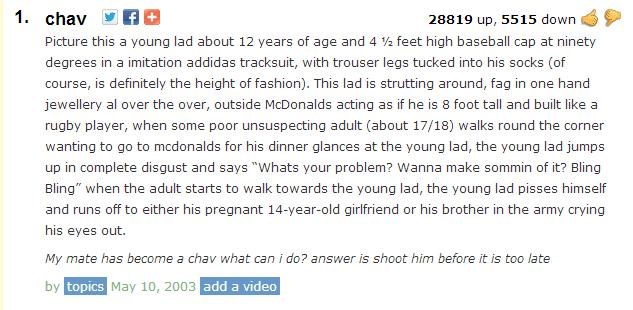
And while we had no clue what exactly a chav was, Urban Dictionary has a pretty spectacular definition that it’s worth quoting verbatim: