
Yesterday Facebook announced its third quarter results, and while we (and really, investors) should have all sat back and marveled at what the social network has accomplished, a few slips managed to outshine the successes. The problem is that for some of the most important, positive things Facebook had to announce, there was a giant “but” attached.
Facebook saw a 60 percent revenue increase this quarter, but … after-hours trading saw a Facebook stock go on an indecisive roller coaster ride.
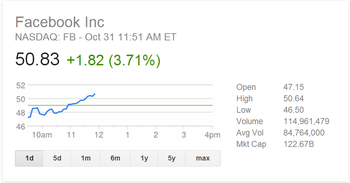 There was a lot of good news for Facebook investors during the Q3 call, but that couldn’t completely cover up all of the other news about the social network going on. Reports about Facebook investigating cursor-tracking technology – which could have been spun as the latest way the platform wants to fix the News Feed – ended up being another “Facebook is stalking you!” fear-mongering story (not that that isn’t justified … it is; it’s just that Facebook failed to take control of that spin). Also, last week’s back-and-forth over whether beheading videos are OK or not was a sore spot.
Facebook now has 874 million monthly mobile users, an increase of 45 percent year over year but … admitted for the first time that teens are losing interest.
The “Facebook is so over!” battle cry has long been staked around the fact that the younger, mobile-focused, social networking-exposed generation isn’t that into it. Newer, more agile apps like Snapchat, Tumblr, Instagram – and even Twitter – keep making noise as the new era of social that will take over Facebook. And now, Facebook has finally commented on the trend.
“Among U.S. teens, [we saw] stable overall [use] from Q2 to Q3,” CFO David Ebersam said during the call, before explaining, “… but we did see a decrease in daily users partly among younger teens.”
And then, he said the worst thing he possibly could: “We remain close to fully penetrated among teens in the U.S.” If anything in this world is true, it’s that the words “teens” and “penetrated” don’t belong in the same sentence.
The “but” here though comes because investors are just interested in all the money Facebook is making now; they’re thinking about the long term. Social investors want to know what the next hot thing is so they can get in on the ground floor and make a killing when it blows up … like people did with Facebook years ago. So now there’s hesitation that Facebook will continue being the social network since it admitted young users are dropping. Part of the reason Facebook has relaxed its privacy policy with teens could easily be to try and lure them into using the social network more.
Instagram is one of Facebook’s big connectors to this teen market, and to the new wave of “natural” advertising, but … that’s not a new number.
 Instagram is sitting at 150 million monthly active users, which is the same number we last heard. Is this backlash to the launch of ads? Frustration with user experience issues that haven’t been addressed (discovery; more personalized privacy controls; search)? Just … your basic burn out? The original 150 million was announced about two months ago, but it’s a strange thing to reannounce when there was no change.
Ads were a huge source of new revenue for Facebook, mobile ads alone accounting for 49 percent of the company’s total ad revenue but … it’s going to start limiting them in News Feed.
Part of this is likely because of its turned-off teen syndrome. Because News Feed doesn’t flow as fast as Twitter and because user posted content looks and sounds much different than Sponsored Posts and ads do (whereas Twitter, Instagram, and Tumblr have a more natural approach to advertising that at least blends in easier), they stick out like a sore thumb. And since we have so many other problems with News Feed, not being able to evade ads and not seeing the content we want means we could get very unmotivated to login at all.
Of course limiting ads is a tough pill to swallow for Facebook, since they’re bringing in so much money. Though, it’s great news for us, and if it results in more logins and teen use, then it will have been a worthwhile compromise for Facebook to make. Still, that can’t be easy for investors to hear: “This thing that’s making all our money? Yeah we’re going to cut back on that.”
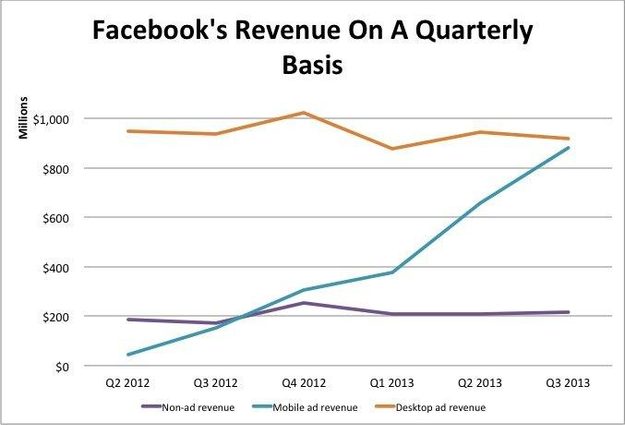
None of this means Facebook is over – not even close. The way it’s attacked mobile (and mobile ads) is proof enough that its mobile-first strategy is really starting to pay off, and despite losing ground with teens, user and usage numbers continue to climb.
But – and this is the most important “but” – the growth has slowed, trickling in at a more gradual pace than the explosive jumps Facebook used to enjoy. If we’re being incendiary, we could say we’re looking at the beginning (the very, very, very beginning) of the end. Facebook may not see massive spikes in new users or daily usage, but it’s still on it’s way up, as earnings report after earnings report has proven, which – despite all the “buts” – puts it in the very favorable spot of mostly being able to compete with itself. Because a “bad” day for Facebook is a spectacular one for just about any other platform.


