1. Home
  2. Space
  3. Emerging Tech
  4. Smart Home
  5. Web
  6. Legacy Archives

Virgin Galactic’s SpaceShipTwo makes first solo flight

Add as a preferred source on Google

Commercial space travel has gotten one small step closer to reality, as Virgin Galactic’s SpaceShipTwo completed its first manned free flight, closing from an altitude of 45,000 feet down to a successful landing at Virgin’s Mojave Air and Spaceport. The SpaceShipTwo, dubbed the VSS Enterprise, was piloted by Pete Siebold, with Mike Alsbury as co-pilot.
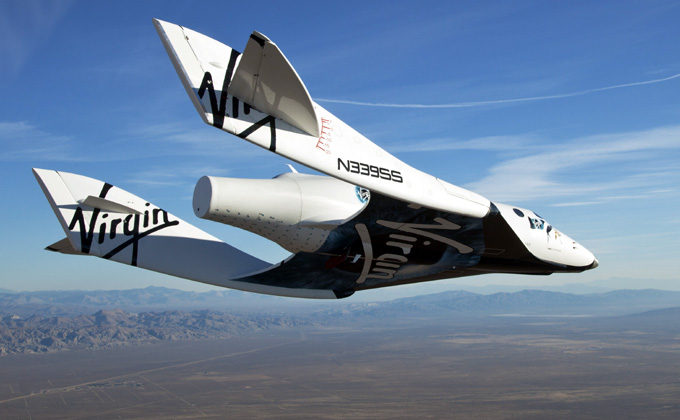
Image used with permission by copyright holder

“This was one of the most exciting days in the whole history of Virgin,” said Virgin Group founder Sir Richard Branson, who was on hand for the flight. “For the first time since we seriously began the project in 2004, I watched the world’s first manned commercial spaceship landing on the runway at Mojave Air and Space Port and it was a great moment. Now, the sky is no longer the limit and we will begin the process of pushing beyond to the final frontier of space itself over the next year.”

Recommended Videos

The first free flight of the SpaceShipTwo craft comes after a series of captive carry flights (the first was back in March), in which the VSS Enterprise was carried aloft by the custom-built WhiteKnightTwo mother ship, dubbed Eve. When Virgin Galactic enters operation, the craft will be taken up to a high altitude by a conventional plane then released: at that point, a rocket booster will propel the craft out of the atmosphere. Re-entry is like NASA’s Space Shuttle: a controlled glide to a pre-defined landing point. The free flight confirmed that the VSS Enterprise’s flight systems were all functioning correctly.

“The VSS Enterprise was a real joy to fly,” said pilot Pete Siebold, “especially when one considers the fact that the vehicle has been designed not only to be a Mach 3.5 spaceship capable of going into space but also one of the worlds highest altitude gliders.” Siebold was also the pilot for SpaceShipOne, the craft that won the Ansari X-Prize. Among other achievements, SpaceShipOne was the first private craft to go over 100km in altitude, and the first private reusable manned spacecraft.

Virgin Galactic has lined up some 370 customer deposits totaling some $50 million for what it will be the world’s first commercial passenger space flight operation.

Geoff Duncan
Former Contributor
Geoff Duncan writes, programs, edits, plays music, and delights in making software misbehave. He's probably the only member…
Space is becoming Bezos and Musk’s next data center site, and we have every reason to worry
The AI boom is coming for the night sky
How Vast's space station will look in orbit.

AI data centers already consume vast amounts of electricity and water on Earth, so Silicon Valley has begun looking somewhere considerably more spacious... literally.

Elon Musk's SpaceX and Jeff Bezos' Blue Origin, along with several other companies, have proposed enormous constellations of satellites designed to operate as orbital data centers. However, environmental groups and former space officials are now warning that putting them into orbit at the proposed scale could have severe consequences for Earth's atmosphere and the night sky.

Read more
The first possible exomoon is here, and it makes our Moon look hilariously tiny
Scientists may have found the first exomoon, except this one is the size of Jupiter
This artist’s concept depicts a potential volcanic moon between the exoplanet WASP-49 b, left, and its parent star. New evidence indicating that a massive sodium cloud observed near WASP-49 b is produced by neither the planet nor the star has prompted researchers to ask if its origin could be an exomoon.

We have already discovered more than 6,000 planets outside of our immediate neighborhood. Yet, finding a moon orbiting one of those distant worlds has proved considerably harder. Astronomers may finally have something close to the real deal, but this particular object stretches the word “moon” almost beyond recognition.

Using the European Southern Observatory’s Very Large Telescope in Chile, researchers detected strong evidence for a moon-like object in the CD-35 2722 system. Further observations are still necessary to confirm the discovery, but it could become the first confidently detected natural satellite outside our solar system. There is still one tiny complication though. This moon is apparently massive.

Read more
China’s answer to SpaceX’s reusable rockets literally catches boosters in a net
SpaceX catches boosters on legs. China just used a net.
Ammunition, Missile, Weapon

SpaceX's playbook for recovering a rocket booster generally involves legs, a precisely controlled vertical landing, and either a concrete pad or a drone ship. 

China just managed to pull off something similar, but in a slightly different way, and on July 10, it tested the method as well.

Read more