


Over the years, cycling component manufacturers have gone to great lengths to find ways to improve the bikes that we ride. Frames have gotten lighter and stronger, chainsets have gotten smoother and more efficient, and brakes have transitioned from pads to discs, all in an effort to cut weight and improve safety, while also getting faster. Over that time, the bike saddle has often been overlooked, forcing riders to settle for seats that are often uncomfortable and based on decades-old designs. Today, that all changes as Specialized has unveiled a completely new technique for designing and building bike seats that it claims will revolutionize the industry forever.
Using a process called Digital Light Synthesis (DLS), Specialized has developed what it calls Mirror Technology, a material that is far more tunable and versatile than traditional foam padding. So much so that the company says that Mirror can replace padding at every cycling touchpoint and will reflect a rider’s anatomy to help improve comfort and stability, while also reducing the possibility of injury. Essentially, that means seats that are better suited for both men and women and their individual needs.
The DLS process, which was created by a company called Carbon, allows designers to use liquid polymers to 3D print the complex lattice structure that makes Mirror Technology unique. This has the added benefit of greatly speeding up the development time for Specialized designers, allowing them to reportedly produce 70 different saddle designs in a single year. Perhaps even more impressive is that the process is so quick and efficient that a new design can go from a prototype to a rideable sample in a single day, allowing for the strengths and weaknesses of individual designs to be evaluated much more quickly.
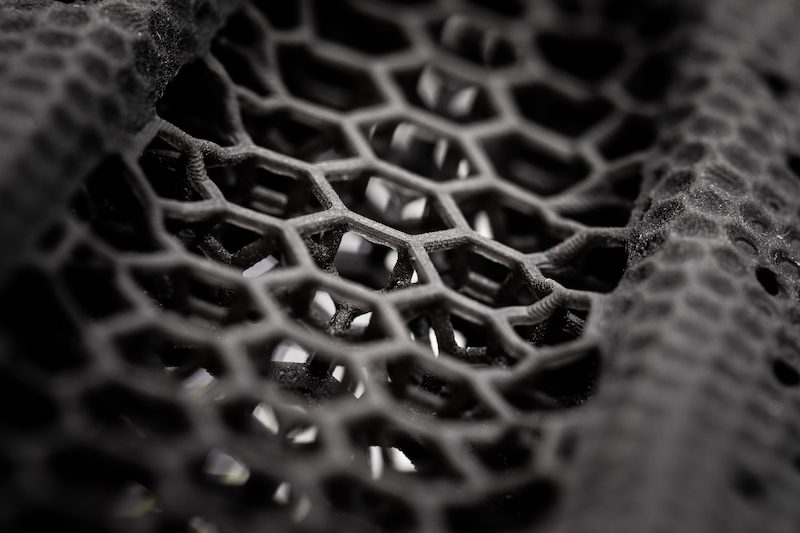
Specialized says that the Mirror lattice that was created using the Digital Light Synthesis process is made up of 14,000 struts and 7,799 nodes, each of which can be individually tuned. That provides far more flexibility in how the company designs its bike seats, giving it the ability to set the softness and rigidity in ways that have never been possible before. In fact, Mirror designers say that in order to replicate their seats using traditional materials a manufacturer would have to use literally thousands of different densities of foam in a single saddle.
What does that mean for cyclists? Reportedly, the Mirror Technology has already been scientifically validated to improve sit-bone comfort for both male and female riders. Beyond that, however, the material will also dampen vibrations and deliver increased pelvic stability, which should translate into better comfort, particularly on longer rides. Specialized says that Mirror also allows for penile blood flow in men by reducing soft tissue pressure as well. That could address a major criticism of traditional bike saddles as well.
Currently, several of Specialized pro riders are testing a prototype Power Saddle that uses Mirror Technology, both on the road and in the mountains. If things continue to proceed as expected, the company says that it expect to release the first new model in early 2020. There is no word on the price or weight of the seat as of yet.
To find out more about Mirror Technology visit the Specialized website.


