1. Home
  2. Emerging Tech
  3. News

This super-bright LED is like holding a mini sun in your hands

Add as a preferred source on Google

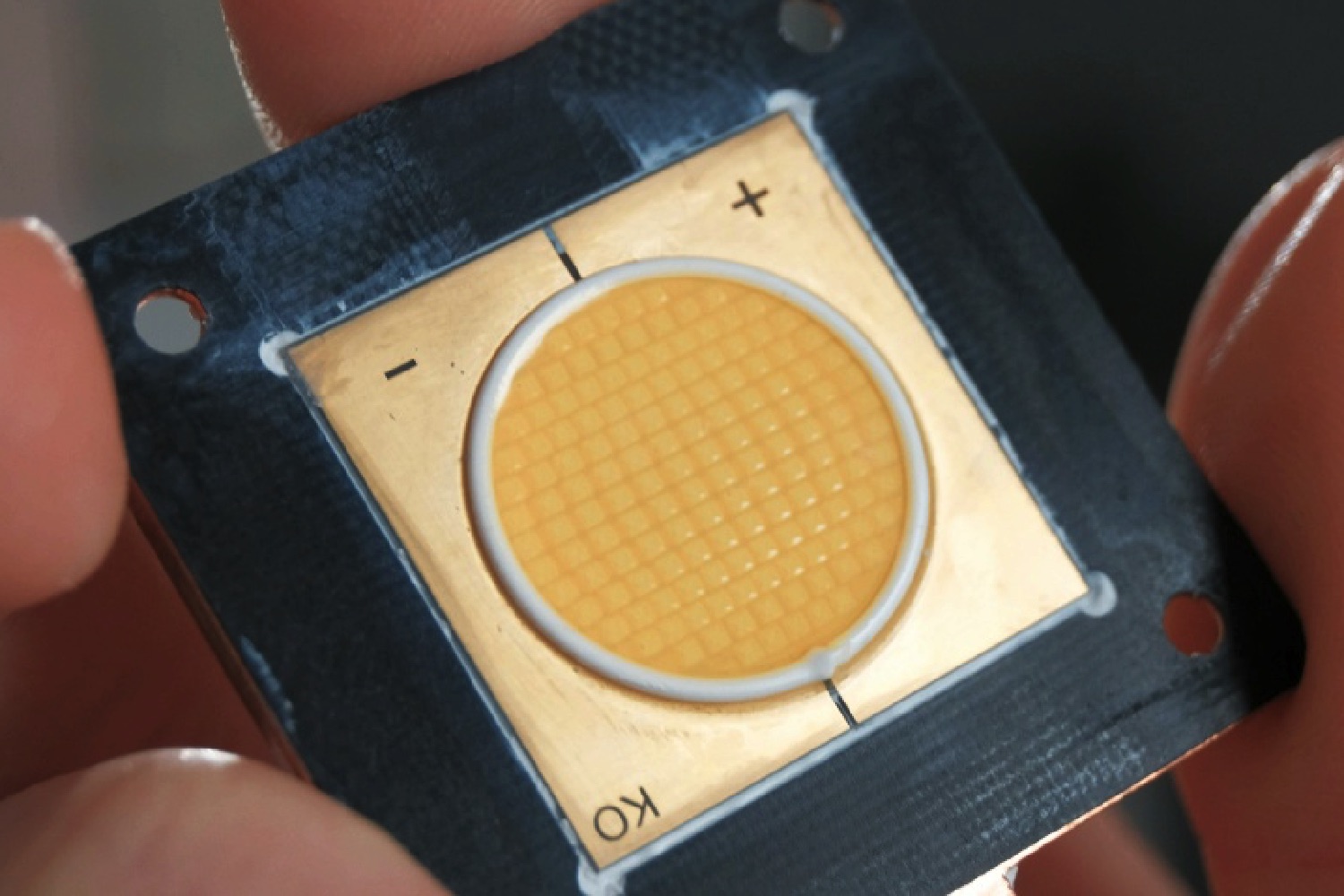
Light-emitting diodes have played a part in a number of the cool projects we’ve covered over the years here at Digital Trends, but rarely have we been quite so in awe of an LED as we are of Yuji LED’s mighty “Daylight 5600K.” A totally different animal to the kind of diminutive LED light you’ll find used as the flash on the back of a smartphone, the $500 Daylight 5600K pumps out a massive 500 watts of light. That’s $1 per watt, and more than enough light to illuminate a decent sized garden at night.

The Daylight 5600K is the subject of a new YouTube video by popular U.K.-based vlogger DIY Perks. Based on the fact that the video has already garnered upwards of 600,000 views on YouTube within a couple of days of it being posted, we’re not really going out on a limb when we conclude that other people are going to be equally interested in it.

Recommended Videos

“The idea behind the video was to show how far LED technology has come,” Matthew Perks, the creator of the video, told Digital Trends. “One of my favorite aspects of the particular 500w LED I tested is its colour rendition. Honestly, it is up there with the nicest ‘daylight balanced’ light sources that I’ve come across, and because of this it makes it usable for lighting applications that require a ‘nice’ looking light source, like installations or studio lighting. Hopefully the video will bring attention to this, and inspire people to come up with some innovative lighting solutions.”

As Perks notes, array-style LEDs like this one are a bit different from the usual LEDs you’ll find in a flashlight, or the aforementioned flash on a smartphone, because they’re made up of a grid, or array, of much smaller diodes. Each one emits light, and due to the fact that they are packed so tightly together they appear to be a single unit.

“The biggest surprise for me was when I took it outside to test it out,” he continued. “I was blown away with how well it lit up my surroundings, and it was surprisingly empowering. It might have been night, sure, but I had a small sun in my hand and I could see everything with detail all around me. Very cool indeed!” Who are we to argue?

Luke Dormehl
I'm a UK-based tech writer covering Cool Tech at Digital Trends. I've also written for Fast Company, Wired, the Guardian…
Google Sheets can now turn your boring spreadsheets into mini-apps
Logo, Text, Clapperboard

I spend enough time inside spreadsheets to know how quickly they can get out of hand. What starts as a neat table can eventually turn into hundreds of rows, endless columns, and a whole lot of scrolling to find the one thing you actually need. Google thinks Gemini can make that experience a lot less painful.

The company is introducing Sheets canvas, a new Gemini-powered feature that can take the data sitting inside a Google Sheets spreadsheet and turn it into something closer to a custom mini-app. Instead of manually building charts, formatting cells, or figuring out complicated formulas, you can tell Gemini what you want to create. For example, you could ask it to turn a spreadsheet full of assignments into a visual study tracker. Gemini will then use the information already sitting in your sheet to build an interactive interface around it.

Read more
Heart X1 soars for the first time as the world’s largest electric aircraft, and the flight cost just $5 in electricity
Aircraft, Airplane, Transportation

Electric cars have become a pretty normal sight on the road, but replacing jet fuel with batteries gets considerably more complicated when you’re trying to lift thousands of pounds into the sky. Heart Aerospace has just shown that it can be done at a surprisingly large scale.

The company’s X1 demonstrator has completed its maiden flight, becoming what Heart says is the largest battery-electric aircraft ever flown. The X1 has a 106-foot wingspan, stretches 76 feet from nose to tail, and weighs more than 25,000 pounds at takeoff. The piloted flight took place on August 12 at Plattsburgh International Airport in New York and lasted 27 minutes. During that time, the X1 climbed to 1,100 feet above ground level, while its battery-powered propulsion system delivered more than one megawatt of power.

Read more
AI’s new cancer-screening partner has four legs and a very good nose
A 10-minute breath sample could give cancer-sniffing dogs something important to say
Dognosis, Indian Startup training AI and Dogs for cancer-screening Featured Image

AI apparently doesn’t need to replace every biological system. Dogs are still keeping their jobs, at least for now. An Indian startup from Bengaluru, Karnataka, is training dogs with sensors and machine learning. Patients breathe normally into a face mask for about 10 minutes, ship the sealed sample to a lab, and let the dogs get to work.

The dogs are trained to identify changes in volatile organic compounds, or VOCs, associated with cancer. Sensors meanwhile track signals including movement, respiration, brain activity, and body language, which Dognosis’ AI translates into standardized data rather than relying entirely on a human handler interpreting each animal’s behavior.

Read more