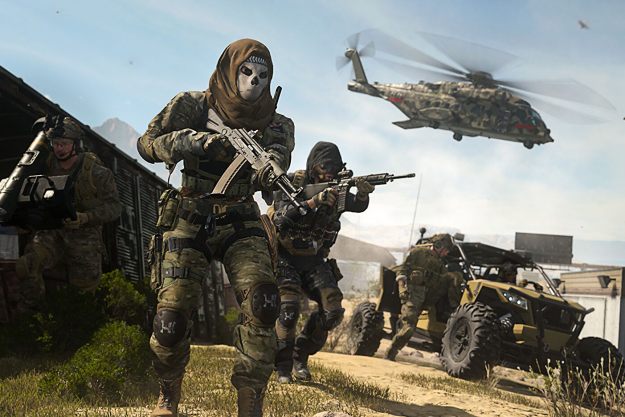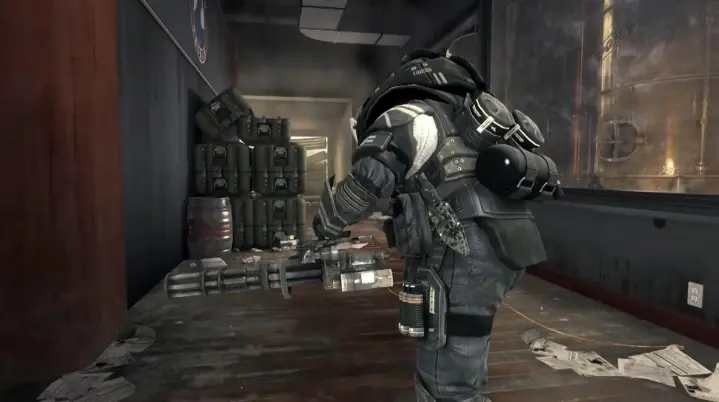
Activision and Infinity Ward have released a new trailer for the upcoming Call of Duty: Ghosts, focusing on the “Squads.” Squad play was a highlight of the recent multiplayer reveal, but the trailer gives a little more context.
Squad play is its own mode in the game, separate and unique from the multiplayer, offering both competitive and co-op gameplay against both AI and other humans. Each player will be tasked with setting up their own squad made up of AI controlled bots with individual loadouts. The player can then take on a team of completely AI controlled bots alongside their own bots. It is an evolution of the current bot games that pair you with random bots, but it is only one part of the Squad mode.
The ability to select your team’s loadout means you can actually have teammates working as a real unit, complimenting each other. It’s always useful to carry something like a rocket launcher to take out aerial objects, but it isn’t always the best choice for a solo player. Now you can let your bot do the heavy lifting. The squad loadout has greater consequences though.
In squads, you can take on entirely AI-controlled teams, or go up against a single player or group of humans complimented by AI bots. You can play alone or with friends of your own, and any open spots will be filled by your bots. That means there will be some strategy involved in who you bring into a multiplayer game, but the selection process carries even more weight.
When you are offline, a human player can challenge your squad even when you are not there. You will need to have your team set up and ready to go, and you pre-select the map and mode, but the game is then played out with an AI representing you. While offline fighting a friend or stranger, you will still earn experience points you can use in the multiplayer mode.
The Squad mode game type, “Safeguard,” is a survival mode, aka horde mode, aka fight off waves of enemies for as long as you and your friends can. A co-op survival mode is nothing new for an online shooter, but the previous Call of Duty survival mode limited you to two players, where as Safeguard allows four.
There will be multiple Safeguard modes as well. The first, just called Safeguard, challenges you to survive 20 rounds; the second, “Safeguard Extended,” goes up to 40 waves; the third, “Safeguard Infinite,” has no round limit.
All game modes will be available on the current gen edition of Call of Duty: Ghosts when it is released on November 5. The next gen versions will be available as launch titles for both the PS4 and the Xbox One on November 15 and November 22, respectively.
Editors' Recommendations
- Call of Duty: Warzone Mobile is out to eliminate mobile gaming’s stigma
- The best weapons in Call of Duty: Modern Warfare 3
- Call of Duty: Modern Warfare III trailer teases a No Russian reimagining
- Does Call of Duty: Modern Warfare 2 have Hardcore mode?
- These 6 Call of Duty: Warzone Season 5 changes are a step in the right direction