
“Sure, the XP-420 is a basic all-in-one printer -- but at just $80 bucks, this Epson is hard to beat.”
- Good features for the price
- Uses separate ink tanks for each color
- Large color LCD panel for a low-cost MFP
- Slot for printing directly from an SD card
- Output okay, but not really photo quality
- On the slow side
- No ADF or duplexing
“Why you can trust Digital Trends – We have a 20-year history of testing, reviewing, and rating products, services and apps to help you make a sound buying decision. Find out more about how we test and score products.“
Years ago, an advertising campaign extolled the virtues of “thin and rich.” The ads talked about cigarettes, however; when it comes to printers, “small and cheap” seems a bit more reasonable.
Epson’s Expression Home lineup of MFPs hits that nail on the head. These units are lumped under the banner of “Small-in One” (a play on all-in-one of course) and are three-function models — they print, copy, and scan. If you need fax capability you’ll have to pay a bit more for an Expression Premium or Expression Photo model that adds this functionality.
And at a street price of around $80, the otherwise humdrum Expression Home XP-420 is a remarkably good deal.
What’s in the box
The XP-420 is a three-function device, so there’s no fax telephone cord packed in the box. What the box does contain is the XP-420 itself, a power cord, a CD containing print and scan drivers, a setup poster, and a very short user’s guide. There’s a set of starter ink cartridges, too — no word on their capacity, strangely.

This Expression Home model can’t print on CD/DVDs, so no special tray is included, nor is a USB cable. You’ll have to provide your own or use Wi-Fi to connect to the MFP. It’s a no-frills product with no frills in the packaging to clutter up the box either.
Features and Design
All of Epson’s “Small-in-One” models are physically slight and light. The XP-420 measures only 15.4 × 11.8 × 5.7 inches when the input and output trays are not extended and weighs in at just 9 pounds. You’ll need a bit more room to actually operate the device as the dimensions increase to 15.4 × 20.8 × 11 inches when the trays are extended.
Paper is fed from a hopper at the rear, which folds down and hides behind a hinged flap when the printer is not in use. This input tray has a capacity of 100 sheets of letter or legal paper, while the output tray, which you pull out from the bottom of the front panel, can hold somewhat fewer. Epson doesn’t give the capacity, but the tray was pretty filled after a performance test runs of 44 pages.
The XP-420 has built-in templates to produce lined paper as well as calendars, a nice extra.
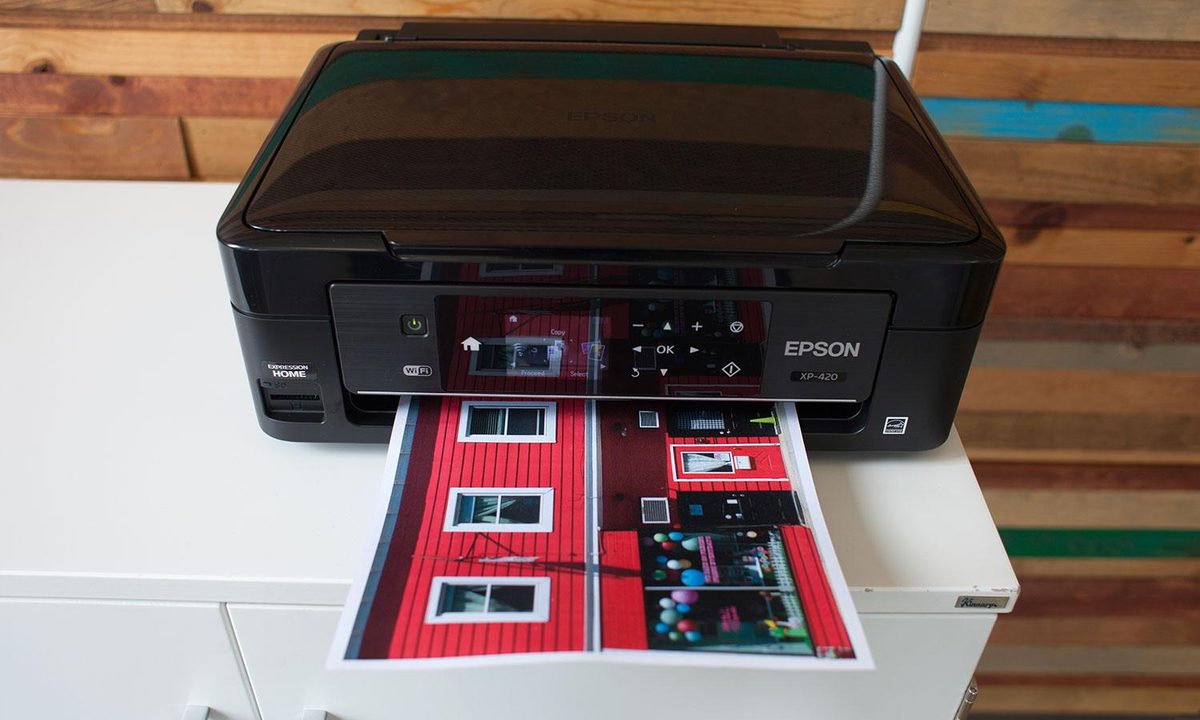
There’s nothing fancy about the XP-420’s looks or layout. The top panel is hinged and swings up to allow access to the scanner platen. There’s no ADF, nor does the MFP offer print duplexing.
The somewhat limited controls are on a tilting section on the front, with a very clear and crisp 2.5-inch color LED panel. This is not a touch screen, but a four-arrow touch panel, with an OK button in the center that makes it easy to navigate through the screens.
Given how inexpensive the XP-420, we were pleasantly surprised to find an SD Card slot on the bottom left of the front panel. While the output isn’t quite photo quality, you can print photos directly from the flash card without using your computer. You can also scan directly to Facebook if your network (or PC/Mac) is connected to the Internet. You can also do basic photo editing from the MFP using the LCD screen and control arrow buttons. The XP-420 also has built-in templates to produce lined paper as well as calendars, a nice extra.
Many low-cost printers and AiOs use a two-cartridge system, with black and tri-color cartridges. Out of cyan? Throw out the rest of the color cartridge. Yuck. The XP-420 fortunately isn’t one of these. It has four separate ink tanks and uses Epson’s DuraBrite Ultra pigment-based inks.


The 220 cartridges provide approximately 175 pages for the black cartridge, 165 pages for the Cyan, Magenta, and Yellow, and cost about $18 for the black and $13 for each of the color cartridges. A better buy are the 220XL cartridges, which provide about 500 pages of printing from the black cartridge and 450 pages from the color cartridges with the black cartridge priced at about $30 and the color cartridges $17. As with many inexpensive inkjets, a full set of XL replacement cartridges will cost about the same as the device originally did.
Setup and performance
Setup provided no surprises. The XP-420 doesn’t have a wired Ethernet port, but it does have USB and can connect over Wi-Fi or using Wi-Fi Direct. Wi-Fi Direct generally cuts the device off from the Internet, losing the Scan to Cloud or Facebook capabilities. As with all Epson printers these days, the XP-420 provides connectivity through Apple AirPrint, Google Cloud Print, and Epson’s own Epson Connect.
We installed the ink cartridges, waited for the printer portion to prime, and installed the drivers. We connected through Wi-Fi using WPS (Wi-Fi Protected Setup), which just requires that you press the WPS button on your router or access point and wait for the device to find and connect to the XP-420.
A full set of XL replacement cartridges will cost about the same as the printer originally did.
Epson doesn’t rate the Expression Home XP-420 as particularly fast; the company says you can expect about 9ppm in black, 4.5ppm in color. With our mostly black document set, we topped out at 7ppm — not particularly fast, but not too sluggish either.
Print quality was a mixed bag. We tested using three papers: Epson Glossy Photo Paper, Epson Premium Presentation Matte, and Hammermill Color Copy Digital, a paper that’s a bit brighter than other Hammermill papers we’ve used in the past. Prints were somewhat light with the photo and presentation paper and a bit on the dark side using the Hammermill paper. If you are going to use the XP-420 for printing photos, stick with photo paper for the best results.
Scanning was on a par for this price point. Scans were somewhat slow, but the output was quite useable. Copying was a drag, and made worse by the lack of an ADF or duplex scan or print capability. Scanning and copying are definitely there for convenience, but we wouldn’t count on them for moderate to heavy use.
Conclusion
The old adage that “You get what you pay for” definitely applies to the Expression Home XP-420. It’s somewhat slow compared to many other inkjets, and output quality, while fine for reports and such, suffers when printing photos. The standard 220 ink cartridges are inexpensive, but offer less than 200-page estimated yields.
Having said that, these characteristics are more than acceptable in a multifunction device that scans and copies too, especially one with a street price of under $80.
While the XP-420 wouldn’t be our first choice for a family that prints a lot, or one that needs photo quality output, it’s a pretty good deal if you want to reward a middle school student with his or her own printer. It’s also inexpensive enough to have around as a back-up in case your main print device fails in the middle of an important job — or if you find the family is hogging the printer.
Highs
- Good features for the price
- Uses separate ink tanks for each color
- Large color LCD panel for a low-cost MFP
- Slot for printing directly from an SD card
Lows
- Output okay, but not really photo quality
- On the slow side
- No ADF or duplexing