Hot on the heels of the overnight success that is Google+, Facebook has been shutting down exporting tools left and right. The site’s taken a beaten for this, and been labeled as trying to keep a iron-clad grip on your data – which it definitely is and probably should. But that doesn’t make it any less frustrating as a user to know that for the most part, you aren’t able to quickly and easily transfer the data you’ve accrued from one social networking profile to another.
While few tools will remain for this specific purpose, there are a few workarounds you can use if you want to pull information from Facebook – which some privacy advocates would advise you to do.
Download your info
 Facebook isn’t the most helpful when it comes to pushing information to another social networking site – in fact, it’s the least helpful. But if you want your Facebook-created data for keeps, there is an option provided on the site. Under your account settings, there’s a link prompting you to download your information. Keywords: Your information. Anything you’ve ever shared on the site will be included – and nothing more. Facebook’s policy specifically says you can’t take anything created by another user. Also important to note is the fact that you can’t pick and choose what you download: Just want photos? Wall posts? Too bad, it’s all or nothing. If we’re being cynical, we’d say this is to dissuade users from doing it.
Tagged photos
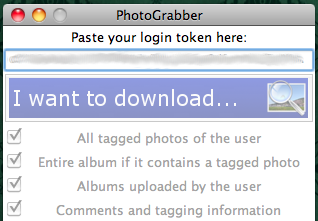 PhotoGrabber is a useful application that will pull all the pictures you’ve ever been tagged in. Why would you need copies? There are plenty of situations in which they would become unavailable to you: If you deactivate your account but still want access to friends’ photos you’re in, if a friend makes all their photos private, if someone shuts down their Facebook account…etc. Or, of course, if you want to grab all those tagged images at once instead of downloading them one at a time and move them on over to, oh say, Google+ (don’t worry, we won’t tell). PhotoGrabber will pull all images (unless protected from third party apps) and deposit them on your hard drive.
Your photo albums
 Given that whole you-can’t-pick-and-choose clause of Facebook’s provided downloading function, you might want to look into how to grab individual pieces of content if you don’t want everything you’ve ever done on the site since college reproduced. If you want to move photos from Facebook to Google+, Move2Picasa makes a copy for you and is incredibly easy to use. FbDownloader is a similar service but puts them on your own system. It has a function much like PhotoGrabber’s as well.
Contacts
This is a big and nearly impossible one. Facebook has been busy continuously blocking tools that import contacts. There remains one tiny loophole thanks to Yahoo, however. Create a Yahoo email account, and then choose the contacts tab. From there, pick import contacts and choose the Facebook logo. Then go to tools, and choose export. Download the file as a CSV. Then import these contacts into Gmail, and you should be able to add them to your Google+ circles.

Editors' Recommendations
- What does a check mark mean on Facebook Messenger?
- How to set your Facebook Feed to show most recent posts
- Instagram Threads: what you need to know, and how to sign up
- You can now use the Add Yours sticker on Reels for Facebook and Instagram
- How to create a Facebook group