  1. Home
  2. Computing
  3. Gaming
  4. News

The Razer Blade of the future could feature OLED screen, 240Hz refresh rate

Add as a preferred source on Google
Razer Blade 15 Advanced
Image used with permission by copyright holder

There’s buzz in the air about OLED laptops at CES 2019. Razer has joined in on the hype, stating its interest in the display technology. More than that, the company brought two future concepts for the 15-inch Razer Blade. One featured a 4K OLED screen, and the other a 240Hz refresh rate.

The success of both display technologies depends highly on the success of Nvidia’s mobile RTX GPUs. 240Hz might feel like overkill now, especially for a thin-and-light gaming laptop like the Razer Blade. The 4K OLED screen, on the other hand, seems tailored to content creators and those with more varied use cases other than just gaming. The first OLED laptops were shown off three years ago, only to have completely dropped off the map. But now, it seems as if the supply chain and demand might be ready for the advanced display technology to start popping up again.

Recommended Videos

Razer Blade Advanced Model introduces Nvidia RTX 20-series

While there’s plenty of excitement for these future Razer Blade laptops, the company is also updating its current lineup of devices with the Razer Blade “Advanced Model.” Based on the Nvidia RTX 20-series graphics cards, these new gaming laptops will show off advanced features like ray tracing and programmable shading. The  Razer Blade Advanced Model can be configured with the RTX 2060, the RTX 2070 Max-Q, or the RTX 2080 Max-Q. These new cards sit alongside the six-core Core i7-8750H and are cooled by the company’s patented vapor chamber cooling.

More CES 2019 coverage

The basic Razer Blade, which uses GTX 1060 graphics and an older thermal system, will still be available starting at $1,600. All models can be configured up to 64GB of RAM and 2TB of PCIe NVMe SSD storage.

1080p 144Hz and 4K 60Hz models will still be offered, the latter of which is touchscreen and claims to achieve 100 percent in the Adobe RGB color space. The Advanced Model with either the RTX 2060 or 2070 will also be available in the Mercury White colorway.

Here’s the kicker: The Razer Blade Advanced Model starts at $2,300. Included in that is the RTX 2060, a 256GB SSD, 16GB of RAM, and a 1080p 60Hz display. For reference, that’s $400 more than the last year’s GTX 1060 configuration.

It will be available for sale starting on January 29 from Razer’s website.

Luke Larsen
Former Senior Editor, Computing
Luke Larsen is the Senior Editor of Computing, managing all content covering laptops, monitors, PC hardware, Macs, and more.
The Mac Pro nearly received an M3 Extreme chip twice as powerful as M3 Ultra
High production costs likely killed Apple’s M3 Extreme plans
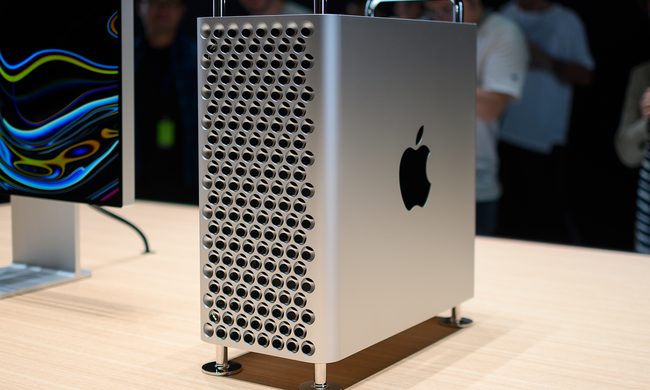
Apple's Mac Pro on a table at a press event.

Apple discontinued the Mac Pro earlier this year, ending a 20-year run for a computer that once represented the very best of the company’s desktop lineup. However, Apple reportedly had much bigger plans for the machine before ultimately replacing it with the Mac Studio.

According to Bloomberg’s Mark Gurman, Apple developed an M3 Extreme chip that could have offered twice as many CPU and GPU cores as the M3 Ultra. The processor was intended to sit above the Ultra tier and could have finally given the Mac Pro the performance advantage it badly needed. Apple eventually abandoned the chip due to concerns over production costs and limited demand for such an expensive machine.

Read more
Hidden prompts can secretly rewrite an AI’s memory, and researchers say that’s a serious problem
Researchers discover AI attack that rewrites an assistant's long-term memory
Chatbot on a smartphone.

Large language models are getting better at remembering us. Whether it's your preferred writing style, recurring tasks, shopping habits or project deadlines, AI assistants are increasingly storing long-term memories to make future conversations feel more personal and useful. But according to new research, that same feature could become one of AI's biggest security vulnerabilities.

Researchers from New Mexico State University have demonstrated a new attack called GhostWriter, capable of secretly planting false memories inside AI agents. Rather than stealing information outright, the attack manipulates what an AI remembers, potentially causing it to make dangerous decisions long after the original attack has taken place.

Read more
This experiment shows how easy it is to poison an open-weight AI model for under $100
This research raises new doubts about trusting open weight AI models.
Computer, Electronics, Laptop

Open-weight AI models have been having a moment lately. Just this month, Moonshot's massive Kimi K3 model landed close behind Claude Fable 5 and GPT 5.6 Sol in several benchmarks, all while remaining fully open-weight and downloadable by anyone.

However, Katie Paxton-Fear, a cybersecurity lecturer at Manchester Metropolitan University and staff security advocate at Semgrep, managed to poison an open-weight model and proved how easily that openness can be turned against you (via The Register).

Read more