
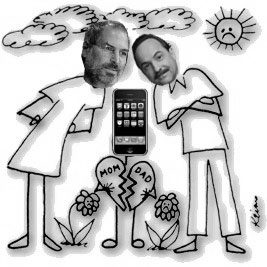
 All the iPhone faithful who have cursed AT&T’s poor reception, dropped calls and shoddy customer service, take heed: Apple feels your pain. And were it not for the gobs of money the company collected from its seemingly incompetent but well-heeled spouse, the two would have divorced years ago.
Like a techie version of an E! True Hollywood Story, a new article in Wired details the uneasy relationship behind the scenes at both AT&T and Apple. Apple CEO Steve Jobs plays the tyrannical Type A wife, AT&T CEO Ralph De La Vega the hapless buffoon of a husband, and the iPhone – the young Hollywood starlet of a child that kept the odd couple paired together in a relentless quest for cash.
According to Wired, Apple considering splitting from AT&T several times, going so far as to send reps to Qualcomm to feel out the possibility of a CDMA iPhone on Verizon. Ultimately, the prospects of a costly hardware redesign from the ground up and legal action from AT&T over its exclusivity agreement kept Apple from ever penning its goodbye note and slipping out into the night.
But there have been some spectacular blowouts.
For instance, after the success of the very first iPhone model began to tax AT&T’s network, carrier reps approached Apple with the prospect of switching YouTube to a Wi-Fi-only feature to ease up the load on the network. Apple’s response: It’s not our problem, and we’re not crippling our product to fix it for you.
The early disagreement seemed to set the every-man-for-himself tone of future battles. Other disagreements have stemmed from Ralph De La Vega’s premature announcement of tethering, Apple’s choice of broadband chips for the iPhone, which hadn’t been proven in the United States, and even how the iPhone should be displayed in the AT&T store (it deserved its own pedestal, Apple insisted).
According to Wired, neither company would say a bad thing about the other through its PR channels for the story, and neither has made an official comment in its wake.


