
“Why you can trust Digital Trends – We have a 20-year history of testing, reviewing, and rating products, services and apps to help you make a sound buying decision. Find out more about how we test and score products.“
Sure the Galaxy S7 Edge has a great camera, and the LG G5 has a innovative modular port — but do they have thermal imaging?
Cat, a rugged phone manufacturer, has collaborated with Flir Systems, to bring its thermal imaging technology into a smartphone. Flir actually has a device called the Flir One, a $250 tool that plugs into an iOS or Android device’s charging port, allowing anyone to get access to thermal imaging on their phone via the Flir One app.
Dust-proof, waterproof, and can withstand drops onto concrete from up to 1.8 meters.
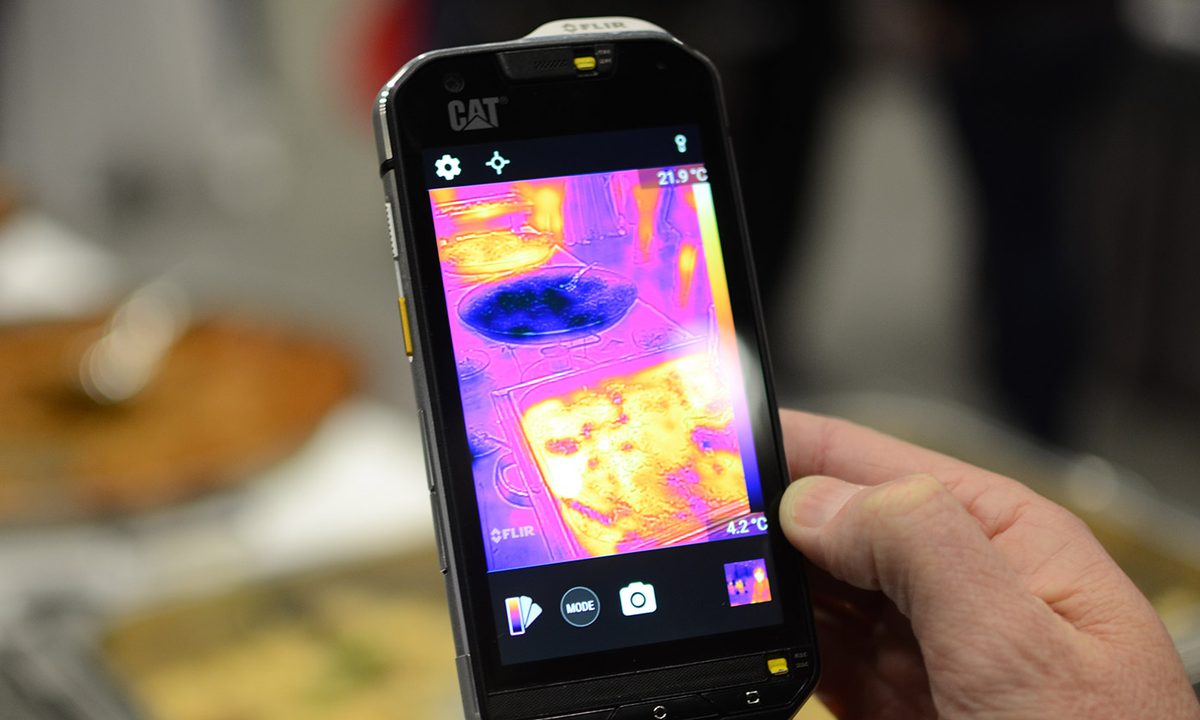
The thermal camera can detect heat loss around windows and doors, and can basically detect anything giving off heat, as long as it’s not hiding behind a thick wall. Cunningham said you will even be able to see hot pipes going along the floor, if they’re close to the surface. With the thermal camera, you’ll be able to navigate in complete darkness, and also measure surface temperatures from a distance of 50 to 100 feet. The heat-sensing tech will be particularly helpful to electricians, plumbers, and construction workers who needs to identify heat loss or excess.
MWC 2016: Sony’s interactive Xperia Projector concept puts the future within reach
The use-cases also encompass helping first-responders, since the device can enable them to see through smoke in the event of a fire. But Cunningham says the average consumer will keep finding new ways to use the thermal camera. At Pepcom during Mobile World Congress, Cunningham took the Cat S60 to platters of food around the venue, and pointed out which dishes were cold, and had been sitting out the longest. The fresher dishes came up as a bright yellow in the camera app.


While that was more of a gimmicky use-case, it’s still an example of the types of ways people will make use of a phone with a thermal camera. One other such way was checking how much propane was left in a tank before firing up a barbecue. The thermal camera can also see the residue of heat left when someone places their hand on a table and takes it away, leaving a sort of ghost heat imprint.
The phone itself is thick, and if you’re getting a Cat phone, you’re not really thinking about design — don’t expect it to look good. The device will be shipping with Android Marshmallow, will be powered by the Qualcomm Snapdragon 617, and will have 3GB of RAM. The Cat S60 has a 4.7-inch Gorilla Glass 4 720p screen, with a massive 3,800mAh battery. It comes with 32GB of internal storage, and you’ll find that the rear camera has a 13-megapixel camera with dual flash, and the front-facing one has 5-megapixels.
MWC 2016: Here’s how to pre-order the LG G5
If you were looking to get a thermal camera on your phone, the Flir One is probably your best bet. But if the Cat S60 piques your interest — well, you probably have been following all the news about it for months. The device is a bit pricey, costing around $600, and it will be available around June of 2016.