
“LG’s 34WK95U-W sets the new standard for ultrawide monitors.”
- Attractive, minimalist design
- Convenient port location
- Easy-to-use menus
- Class-leading image quality
- My god, it’s full of pixels
- Far more expensive than competitors
- No enhanced refresh rate or adaptive sync
- Warranty should be longer
“Why you can trust Digital Trends – We have a 20-year history of testing, reviewing, and rating products, services and apps to help you make a sound buying decision. Find out more about how we test and score products.“
After a decade turning out tepid, appliance-like devices, monitor manufacturers have exploded with creativity over the past few years. Some of the best monitors come in all shapes and sizes, at resolutions between 1080p and 5K — and refresh rates that rise into the hundreds.
There’s even a push to redefine the core LCD technology that’s defined monitors since the CRT’s demise. LG’s 34WK95U-W is one such example. It has many impressive specifications including 5,120 x 2,160 resolution, HDR, and Thunderbolt 3 connectivity. Then there’s the ‘Nano-IPS’ panel, which LG says has “enhanced phosphors” to improve color gamut.
This 34-inch ultrawide is indisputedly impressive on paper, and at a retail price of $1,500, it’d be better. Can this monitor set a new standard for image quality?
Delicate, yet sturdy
The LG 34WK95U-W, like other recent monitors built by the company, offers a striking and unusual profile. Its chassis, clad in sturdy white plastic, looks bright and modern. Most competitors still choose faux-metal silver or a stale, inoffensive black. The LG also has remarkably slim bezels. Other competitors offer the same, but LG’s are among the thinnest.
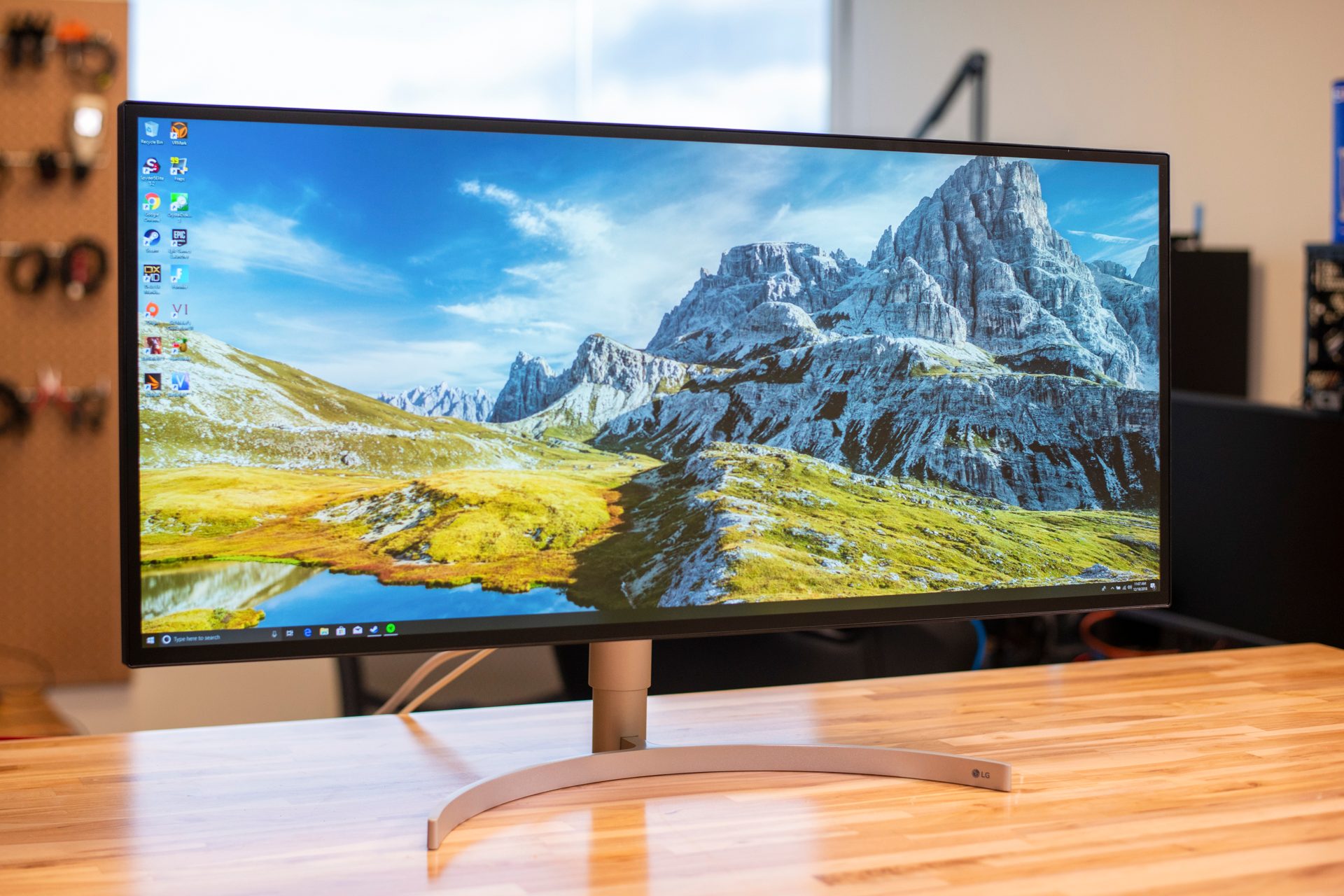


A delicate U-shaped metal stand holds the monitor in place. Its thin profile made us worry about the monitor’s stability, but the stand didn’t disappoint. The screen rarely wobbled and felt as firmly planted as Dell’s U3415DW, a 34-inch ultrawide with a larger, thicker base.
While functional, the LG’s stand does lack versatility. It adjusts for tilt and height, while most competitors also swivel. A VESA mount is available, however, so you can replace the stand if you need a greater range of movement.
More Ultrawide Monitor Reviews
- Samsung CHG90 ultrawide monitor review
- Dell Ultrasharp 49 review
- BenQ EX3501R ultrawide monitor review
Connection options are numerous. They include two HDMI, DisplayPort, USB-C, a headphone jack, one USB-A upstream, and two USB-A downstream. There’s also a Thunderbolt 3 port, so you can use the LG 34WK95U as a one-cable dock with most laptops that support the same. The monitor supports can charge as would an 85-watt power supply.
Almost every competitor in this space uses downward-facing ports, often hidden under a lip on the monitor’s rear. LG instead uses rear-facing powers clustered in a rectangle. That makes connecting devices easy. We like the port locations, though they do complicate matters if you want to wall-mount the display.
A joystick that’s a joy to use
You control the LG 34WK95U-W using a joystick hidden under the middle of the display. This design can often become frustrating if the menu doesn’t respond quickly, but here the response is quick and accurate. We were able to glide through the well-organized menus without a problem. We still like the simple tactile buttons on Dell Ultrasharp monitors best, but LG’s solution isn’t bad. It’s superior to the strangely located controls of the Samsung CF791.
The LG 34WK95U-W’s 5,120 x 2,160 resolution is the highest we’ve seen from any ultrawide screen.
There’s plenty to tweak, as well. You’ll find a variety of picture modes, several gamma presets, manual color temperature controls, and “six color” hue and saturation adjustment. This customization means the LG 34WK95U-W should work for you even if you have specific demands for monitor image quality. With that said, the LG monitor can claim no major advantage here. Most high-end monitors have similar options.
A stunning display
The first thing you’ll notice about the LG 34WK95U-W is something you wouldn’t notice when you look at the specifications. It’s flat.
That’s a bit weird. Ultrawide monitors are almost always curved to offer a more dramatic, immersive experience. LG, however, is marketing this ultrawide as a professional’s tool, so the curve was ditched. It’s not wide to provide the best experience in games and movies but instead to offer professionals extra room for work.

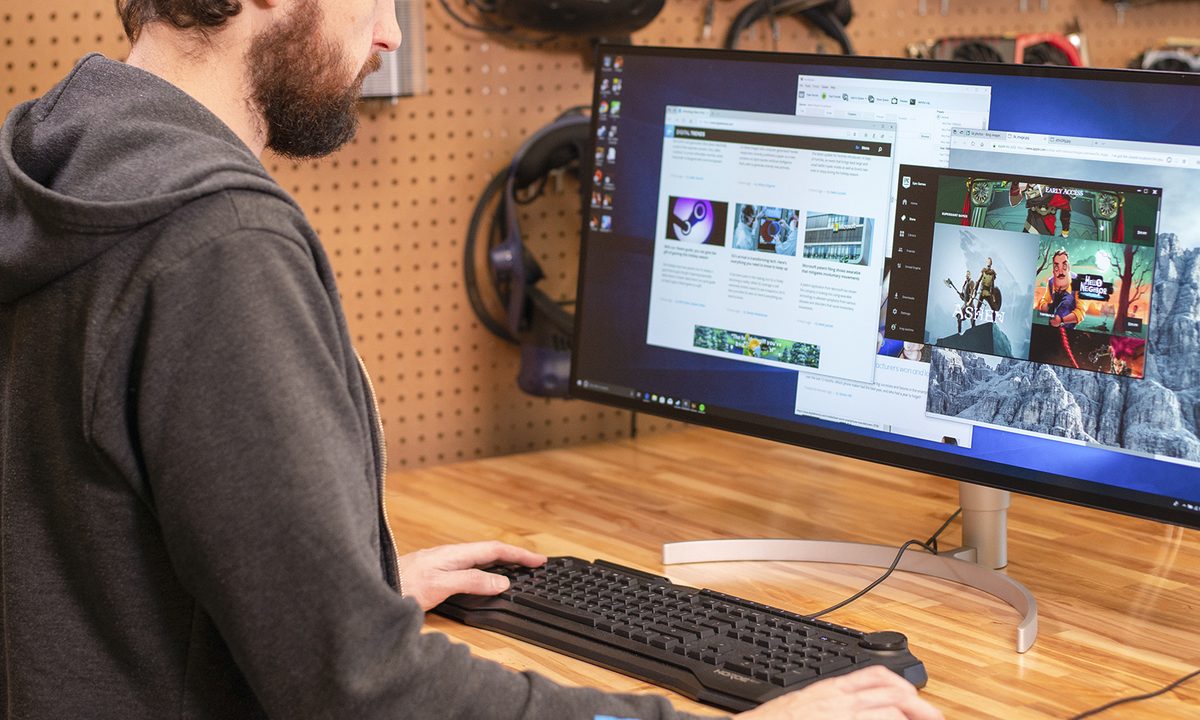
And there’s room aplenty. The 34-inch, 21:9 display is far from the largest – that honor goes to 49-inch, 32:9 monsters like the Samsung CHG90 – but its 5,120 x 2,160 resolution is the highest we’ve seen from any ultrawide screen. Pixels translate not only to sharpness but also usable screen space. You can open and use hordes of apps simultaneously.
“But wait! What about Nano-IPS?” Well, there’s a reason it’s demoted to the third feature mentioned. The name sounds fancy, but it boils down to “nanometer-sized particles” that will “will absorb excess light wavelengths and deliver stunning picture quality.” You might think, based on the name, that LG had somehow miniaturized some aspect of LCD technology, but it’s more of a competitor to Samsung’s Quantum Dot displays. The focus then is not pixel count or size — but color gamut and accuracy.
But in that, it delivers.
It’s hard to find any flaw in the numbers. The worst result is arguably contrast which, at a ratio 770:1, doesn’t beat Samsung’s CF791 or the BenQ EX3501R. Yet even that number exceeds several competitors, including the Dell Ultrasharp U3818DW, Dell Ultrasharp U3415W, and LG 38UC99.
Elsewhere, the LG 34WK95U-W turns in excellent results. It hits 90 percent of the AdobeRGB gamut with an average color error of only 1.1. That’s superior to all the monitor’s competitors. The BenQ EX3501R and Samsung CF791 are close but lose in both tests. The LG even boasts an outstanding gamma curve result of 2.2, which means images displayed look no brighter, or darker, than intended.
And it gets better. The screen supports HDR and has a maximum brightness of 409 nits. That’s among the higher results we’ve seen for any monitor and defeats other HDR-capable monitors we’ve reviewed. HDR-enabled movies and games, like Battlefield V, look fantastic on this screen.

That’s all on top of its 5,120 x 2,160 resolution, which serves up 163 pixels per inch. That’s extremely high for a desktop display and, once again, defeats all competitors. If you want the sharpest ultrawide you can sit on your desk, you’ve found it.
Downsides? As said, the display isn’t curved, so it’s not as immersive in games. There’s also no support for frame-sync technology like AMD’s FreeSync, and the refresh rate is a standard 60Hz. This too will disappoint the gamer in you, though you may forgive these oversights when you see the display with HDR turned on.
It’s hard to improve on the out-of-box quality
We knew we’d have a hard time improving the LG 34WK95-U when we saw its out-of-the-box quality, and we were right. Our attempts at calibration didn’t move the needle. Color accuracy and gamma remained the same, though our post-calibration screen appeared slightly warmer.
The LG 34WK95-U is among the best-looking monitors we’ve ever reviewed.
That’s not to say you can’t adjust the image quality, but it’s excellent at default settings. The changes you make to the image settings may help it conform to your needs, but there’s no glaring flaws to correct with an easy tweak of the contrast, color saturation, or gamma.
Which is good. Most people don’t want to mess with calibration.
Audio quality
The LG 34WK95-U comes with a pair of five-watt speakers. They sound alright, but the result is more serviceable than exciting. Though loud enough for everyday use, the speakers have a muddy quality that does little to help movies and music sound their best. You’ll want to pair the monitor with external speakers or a pair of headphones.
Our Take
The LG 34WK95-U is among the best-looking monitors we’ve ever reviewed. It’s large, has excellent image quality, and will look good on your desk. We can’t help but whine about the $1,500 price tag, however. That’s far more than most people want to spend — and not remotely competitive with other 34-inch ultrawide monitors.
Is there a better alternative?
The LG 34WK95-U is the leader in ultrawide image quality. If you need the very best, look no further.
Price matters, however, and that’s where the aging Samsung CF791 makes a stand. It doesn’t match the LG’s image quality, but it’s very close. It even has some features the LG doesn’t, including a curved screen and AMD FreeSync support.
Given its price, you could also consider larger monitors. Dell’s Ultrasharp 49 also targets professional and workstation owners, and its 49-inch screen dwarfs the LG 34WK95-U.
How long will it last?
Monitors tend to be reliable, so we doubt the LG 34WK95-U will break before you want to toss it out. That’ll be a long time coming, too, as its forward-looking features are impressive. This monitor will look good a decade from now.
We do take issue with the warranty, however, which covers the monitor for just one year. Dell warranties most UltraSharp monitors for three years.
Should you buy it?
Yes – if you need a nearly flawless ultrawide display. The LG 34WK95-U is too expensive to casually purchase, but it sets a new standard in image quality.
There are also more affordable choices that come at a discount. You can check our list of the best desktop monitor deals to learn more.